

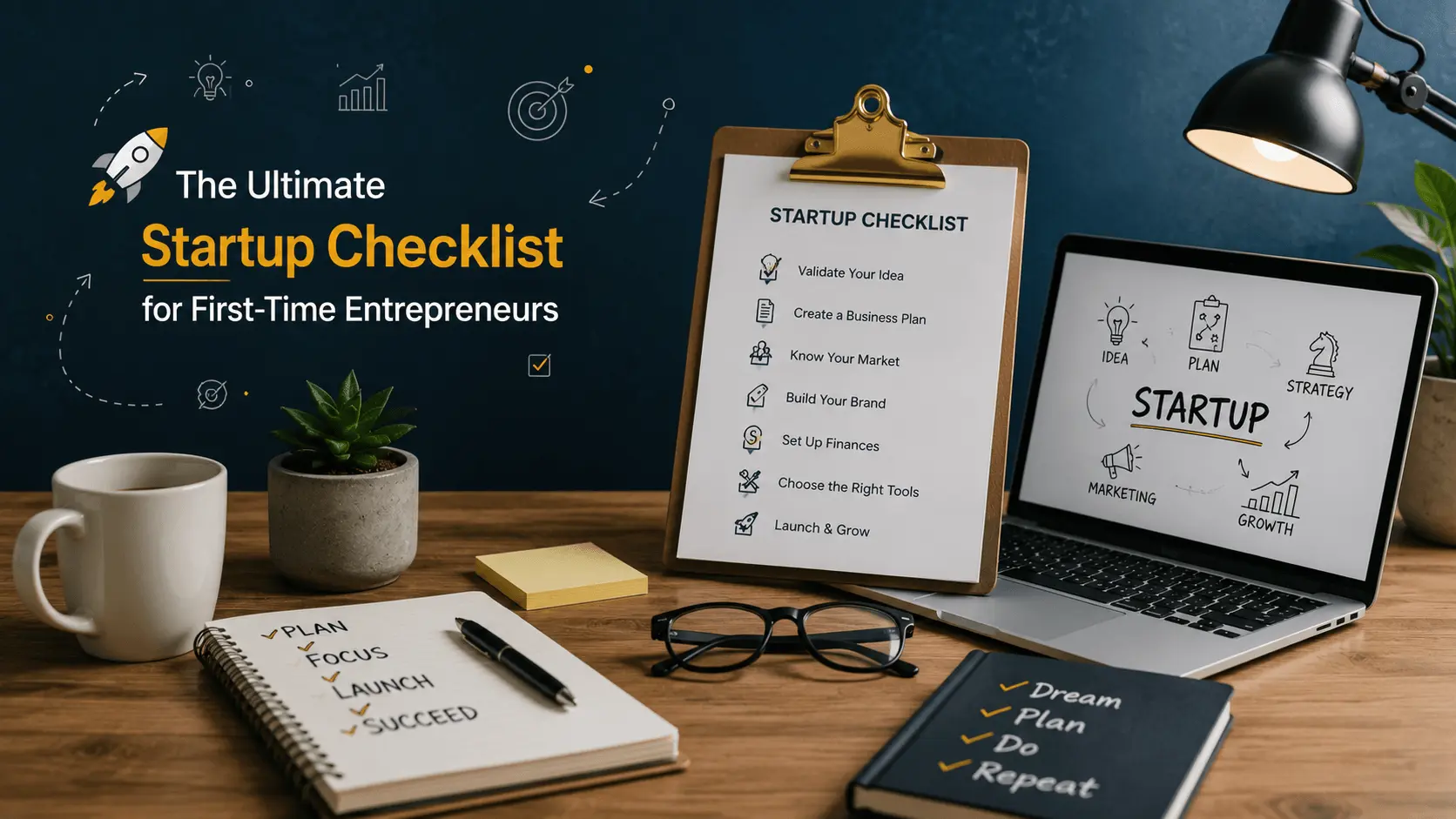
Launching a business for the first time is thrilling, but it is also one of the riskiest financial decisions a person can make. Government labor data shows that roughly one in five new businesses close within their first year, and nearly half do not make it past year five. A separate figure often cited in startup circles puts the lifetime failure rate for innovative, high-growth startups closer to 90 percent. These numbers are not meant to discourage you. They exist to show why a startup checklist for first-time entrepreneurs matters more than motivation alone.
Most failures do not come from a bad product. They come from skipped steps: no market validation, no budget, no marketing plan, and no clear structure. First-time founders often rush toward a launch date instead of building a foundation. This guide breaks the process into 20 clear steps, so nothing important gets missed.
You will learn how to validate your idea, choose a business model, register your company, build a brand, and launch with confidence. This startup business checklist works whether you are opening an online store, a service business, or a physical shop. Whether you call it a new business checklist or a business launch checklist, the goal is the same: fewer mistakes, faster progress, and a stronger start.
Key Takeaways
A startup checklist reduces costly mistakes and keeps first-time entrepreneurs organized from idea to launch.
Validating your business idea before spending money is the single biggest predictor of long-term survival.
Around 4 in 10 startup failures trace back to building something the market never actually needed.
A clear budget, business structure, and marketing plan protect your startup from running out of cash.
Testing your website, checkout, and payment systems before launch prevents lost sales on day one.
Tracking performance after launch turns a one-time event into a growing, sustainable business.
Why Every First-Time Entrepreneur Needs a Startup Checklist
A startup checklist for first-time entrepreneurs turns a vague idea into a series of manageable actions. Instead of guessing what to do next, you follow a proven sequence that other founders have already tested. This structure alone removes much of the stress that comes with starting a business.
Following an entrepreneur checklist reduces costly mistakes because it forces you to validate demand before you spend on inventory, design, or ads. It also saves time and money by preventing rework, such as rebuilding a website because the business name changed halfway through launch.
A documented startup planning checklist improves organization across every department, from finances to marketing. It also helps when you are ready to secure funding, since investors and lenders want to see a structured business plan rather than a rough idea. Most importantly, a clear roadmap makes launching less stressful, because you always know your next step.
The Complete Startup Checklist for First-Time Entrepreneurs
This business startup guide walks through 20 steps in order. Each step includes a short checklist so you can track your progress. Try to complete every step before your official launch date, even if it means pushing the date back by a few weeks.
Step 1: Validate Your Business Idea
Every successful business starts by solving a real problem for real people. Before writing a business plan, confirm that market demand actually exists. Research indicates that a lack of market need is behind roughly 42 percent of startup failures, making this the most important step on the entire list.
Study your competitors to see what they offer and where they fall short. Talk directly to potential customers through interviews or surveys to understand their pain points. Then build a minimum viable product, or MVP, to test your idea with real users before investing further.
Confirm your idea solves a specific, real problem
Research market demand using search trends and industry reports
Study at least five direct competitors
Interview 10 to 20 potential customers
Build and test a simple MVP
Step 2: Define Your Target Audience
You cannot market to everyone, so define exactly who you are serving. Build a customer persona that includes age, income, location, and lifestyle details. Understanding your audience's demographics helps you choose the right products, pricing, and messaging from day one.
Go beyond basic demographics and study your audience's pain points and buying behavior. Ask what frustrates them about current solutions and what would make them switch to a new brand. This research shapes your marketing strategy long before you spend a dollar on ads.
Create one or two detailed customer personas
Document age, income, location, and lifestyle
List your audience's top three pain points
Map out how and where they typically buy
Step 3: Research Your Competitors
Competitor research shows you where the gaps are in your market. Start with a SWOT analysis, examining strengths, weaknesses, opportunities, and threats for your top competitors. This exercise often reveals an opening that your business can fill.
Compare pricing across your competitors so you can position your offer clearly. Study their marketing channels, from social media to email, and read their customer reviews to learn what buyers love and complain about most.
Complete a SWOT analysis for three to five competitors
Compare pricing tiers and value propositions
Identify their top marketing channels
Read at least 20 customer reviews per competitor
Step 4: Choose the Right Business Model
Your business model determines how you generate revenue, so choose it carefully. Options include a service business, an ecommerce store, a SaaS product, a marketplace, a subscription model, an affiliate business, or digital products. Each model has different startup costs and growth potential.
Global ecommerce sales are projected to reach roughly 7.4 trillion dollars in 2026, which shows why so many first-time entrepreneurs choose an online store as their starting model. The table below compares common options.
Business Model | Pros | Cons |
Service Business | Low startup cost, fast start | Time-limited, harder to scale |
Ecommerce | Scalable, huge market demand | Inventory and shipping costs |
SaaS | Recurring revenue, high margins | Requires development resources |
Marketplace | Low inventory risk | Needs both buyers and sellers |
Subscription | Predictable monthly income | High churn risk if value drops |
Affiliate | No product creation needed | Income depends on other brands |
Digital Products | Low overhead, instant delivery | Market can be saturated |
Step 5: Choose a Memorable Business Name
Your business name is often a customer's first impression of your brand, so branding matters from the very start. A strong name is easy to pronounce, easy to remember, and easy to spell out loud. These small details influence how quickly people trust and recognize your business.
Before you fall in love with a name, check domain availability and confirm the social media handles are free. Run a quick trademark search so you avoid legal issues after launch. Choosing a name that checks all of these boxes takes time, but the right tool can speed up the process significantly.
Best Business Name Generator – Ai Bizname
Starting a business begins with choosing the right name, and that decision can shape your brand's identity for years to come. A memorable, professional business name helps build trust, improves brand recognition, and makes marketing much easier. However, brainstorming unique names while checking domain availability can quickly become overwhelming for first-time entrepreneurs.
Ai Bizname simplifies this entire process with an AI-powered Business Name Generator designed for startups, creators, and small businesses. Simply enter your niche or keywords, and the tool generates hundreds of creative, brandable business name ideas within seconds. It also helps you discover unique naming styles that match your industry, making the branding process faster and more enjoyable.
Whether you're launching an online store, local business, SaaS startup, agency, or personal brand, Ai Bizname helps you find a name that stands out from the competition. Instead of spending hours brainstorming, entrepreneurs can focus on building their business while quickly finding creative names that align with their vision.
Step 6: Write a Business Plan
A business plan turns your idea into a document that guides decisions and attracts funding. Include an executive summary, clear goals, and a description of your products or services. Add a market analysis so readers understand who you serve and why.
Round out the plan with financial projections and a marketing strategy. Even a simple one-page business plan template is better than skipping this step entirely, since it forces you to think through the details before spending money.
Executive summary and business goals
Product or service description
Market analysis and target audience
Financial projections for year one
Marketing strategy overview
Step 7: Create a Startup Budget
A realistic budget prevents one of the most common startup killers: running out of cash. List your one-time startup costs, such as equipment, licenses, and website design. Then estimate your recurring operating costs, including hosting, software, and inventory.
Set aside an emergency fund covering at least three months of expenses. Track your cash flow weekly during the first year, since income is often uneven while you build momentum.
Sample Monthly Budget Example
Website hosting and tools: $50–$150
Marketing and advertising: $200–$800
Inventory or software subscriptions: $300–$1,500
Emergency buffer: 10–15% of total budget
Step 8: Decide Your Business Structure
Your legal structure affects your taxes, liability, and paperwork. A Sole Proprietorship is the simplest option but offers no personal liability protection. A Partnership works when two or more people share ownership and responsibility.
An LLC protects your personal assets while keeping paperwork manageable, making it a popular business structure among first-time entrepreneurs. A Corporation offers the strongest liability protection but comes with more regulations and reporting requirements.
Structure | Liability Protection | Best For |
Sole Proprietorship | None | Solo freelancers, low-risk work |
Partnership | Limited | Two or more co-founders |
LLC | Strong | Most first-time entrepreneurs |
Corporation | Strongest | Businesses seeking investors |
Step 9: Register Your Business
Once your structure is chosen, complete your business registration with your state or local government. Apply for any required business licenses tied to your industry or location. Register for tax purposes, including an Employer Identification Number if you plan to hire staff.
Certain industries, such as food service or healthcare, require additional industry permits. Confirm your specific requirements early, since delays here can push back your entire launch timeline.
File business registration paperwork
Apply for local and state licenses
Register for federal and state tax IDs
Secure any required industry permits
Step 10: Open a Business Bank Account
Keeping business and personal finances separate protects your liability status and simplifies tax season. A dedicated business account also makes it easier to track profit and spot spending problems early.
Pair your account with accounting software to automate expense tracking. As your revenue grows, building business credit through this account can help you qualify for loans or better payment terms with suppliers.
Open a separate business checking account
Connect accounting software for automatic tracking
Apply for a business credit card once eligible
Step 11: Build Your Brand Identity
Your brand identity is how customers recognize and remember you. Start with a simple, versatile logo that works across your website, packaging, and social media. Choose a consistent color palette and typography that reflects your business personality.
Define your brand voice, whether that is playful, professional, or bold, and apply it consistently across every channel. Document these choices in brand guidelines, so your messaging stays consistent as your team grows.
Design a simple, scalable logo
Choose 2–3 brand colors and a font pairing
Define your brand voice and tone
Create a one-page brand guidelines document
Step 12: Create a Professional Website
Your website is often your first storefront, so treat it like one. Secure a matching domain and reliable hosting, then confirm the site is fully mobile optimized. More than half of global online sales now happen on mobile devices, so a slow or clunky mobile experience directly costs you revenue.
Add a clear about page and a contact page so visitors can trust and reach you. Cover basic SEO, including page titles and meta descriptions, and install an SSL certificate to keep customer data secure.
Website Launch Checklist
Domain purchased and connected
Reliable hosting configured
Mobile optimization tested
About and contact pages live
SEO basics in place
SSL certificate installed
Step 13: Set Up Business Email & Communication Tools
A professional business email builds instant credibility with customers and partners. Pair it with a CRM to track leads and customer conversations in one place. Tools like Slack keep internal communication organized as your team grows.
Add Zoom or a similar video platform for client calls, and consider Google Workspace to combine email, documents, and storage under one login.
Set up a branded business email address
Choose a CRM for customer tracking
Install Slack for team communication
Add Zoom for client and team calls
Step 14: Build Your Marketing Strategy
A strong marketing strategy combines several channels rather than relying on just one. SEO and content marketing build long-term, organic traffic to your website. Social media builds community and brand awareness, while email marketing nurtures leads into paying customers.
Paid ads can accelerate growth once you understand your numbers, and referral marketing turns happy customers into your best sales channel. Notably, most small businesses that use AI tools now apply them to marketing content creation first, since it is the fastest way to see results.
Marketing Checklist
SEO keyword research completed
Content calendar created
Social media channels selected
Email welcome sequence built
Referral or affiliate program planned
Step 15: Create Social Media Profiles
Choose two or three platforms where your target audience already spends time, rather than trying to be everywhere at once. Keep your branding consistent across every profile, from your logo to your bio wording.
Build a simple content calendar so you always know what to post next. Decide on a realistic posting frequency you can maintain long-term, since consistency matters more than volume.
Select 2–3 core platforms
Match branding across all profiles
Build a monthly content calendar
Set a realistic posting schedule
Step 16: Set Up Accounting & Taxes
Accurate bookkeeping from day one saves major headaches at tax time. Set up a system for invoicing clients or customers quickly and professionally. Plan for quarterly or annual taxes based on your business structure and location.
Track every business expense as it happens rather than reconstructing records later. Many first-time entrepreneurs now use AI-powered accounting tools to automate this process and reduce errors.
Choose a bookkeeping system or software
Set up professional invoicing
Plan for quarterly tax payments
Track expenses weekly
Step 17: Build Your Sales Funnel
A sales funnel guides visitors from first click to paying customer. Start with dedicated landing pages for your key offers, each with one clear call to action. Use lead magnets, such as a free guide or discount code, to capture email addresses.
Set up email automation to nurture new leads automatically over time. Continuously test and improve your funnel through conversion optimization, since small changes often produce meaningful revenue gains.
Landing pages built for key offers
Lead magnet created and connected
Email automation sequences active
Conversion tracking installed
Step 18: Test Before Launch
Testing before launch prevents embarrassing and costly mistakes on your most important day. Click through your entire website as a customer would, checking every link and page. Test your payment gateway with a real transaction to confirm it processes correctly.
Check mobile responsiveness on multiple devices, since most shoppers will visit from a phone. Submit every form on your site and complete a full checkout to confirm the process works end to end.
Full website walkthrough completed
Payment gateway tested with a live transaction
Mobile responsiveness confirmed
All forms submitted and verified
Checkout process tested end to end
Email automation triggers confirmed
Step 19: Launch Your Business
Consider a soft launch first, opening quietly to a small group before your full public debut. This lets you catch issues while the stakes are still low. Follow with a grand launch supported by a clear announcement across your website, email list, and social channels.
To give that announcement something people share, here are 15 product launch videos with real view counts and what made each one work.
Reach out to relevant press or bloggers for coverage, and consider influencer outreach if your audience follows specific creators. If you sell a digital product or app, a Product Hunt launch can generate early traction and feedback.
Run a soft launch with a small audience
Plan your grand launch announcement
Reach out to press or bloggers
Contact relevant influencers, if applicable
Publish your official launch announcement
Step 20: Measure and Improve
Launching is the beginning, not the finish line. Track your revenue weekly and monitor your customer acquisition cost, or CAC, to confirm your marketing is profitable. Watch your conversion rate and website traffic closely during the first few months.
Collect customer feedback consistently and monitor your retention rate, since keeping existing customers is often cheaper than acquiring new ones. Small businesses that actively track these numbers with AI-assisted analytics tools tend to spot problems and opportunities faster than those relying on gut instinct alone.
Recommended Tools
Google Analytics for traffic and behavior
A CRM for customer and retention data
Accounting software for revenue tracking
A survey tool for ongoing customer feedback
Startup Checklist (Printable)
Use this printable startup checklist to track every step at a glance. Check off each task as you complete it, and revisit the list as your business grows.
Task | Completed |
Validate your business idea | ☐ |
Define your target audience | ☐ |
Research your competitors | ☐ |
Choose a business model | ☐ |
Choose a business name | ☐ |
Write a business plan | ☐ |
Create a startup budget | ☐ |
Decide your business structure | ☐ |
Register your business | ☐ |
Open a business bank account | ☐ |
Build your brand identity | ☐ |
Create a professional website | ☐ |
Set up email and communication tools | ☐ |
Build your marketing strategy | ☐ |
Create social media profiles | ☐ |
Set up accounting and taxes | ☐ |
Build your sales funnel | ☐ |
Test everything before launch | ☐ |
Launch your business | ☐ |
Measure and improve | ☐ |
Biggest Mistakes First-Time Entrepreneurs Should Avoid
Even with a solid startup roadmap, certain mistakes trip up new business owners again and again. Avoiding these pitfalls dramatically improves your odds of building a sustainable business.
Skipping market research and assuming demand exists
Choosing a poor or hard-to-remember business name
Launching without a written business plan
Ignoring marketing until sales slow down
Overspending on non-essential tools early on
Skipping idea validation before building the product
Hiring too early before revenue supports it
Operating without financial planning or a budget
Trying to handle every task alone instead of delegating
Startup Tools Every Beginner Should Use
The right tools save time and reduce costly errors. This table highlights dependable options across the most important startup categories.
Purpose | Recommended Tool |
Business Name | Ai Bizname |
Design | Canva |
Website | WordPress / Shopify |
Google Workspace | |
Accounting | QuickBooks |
Marketing | Mailchimp |
Analytics | Google Analytics |
Project Management | Trello |
Final Thoughts
A structured startup roadmap protects you from the most common reasons new businesses fail. Rushing toward a launch date without validation, budgeting, or testing often leads to costly setbacks that could have been avoided. Working through this checklist one step at a time builds a stronger, more sustainable foundation than chasing a quick win.
Revisit this business startup guide as your company grows, since your priorities will shift from launch tasks to scaling tasks over time. Bookmark or download this checklist so you always have it on hand. Start with Step 1 today, and move forward with confidence toward a business built to last.
Frequently Asked Questions
What is a startup checklist?
A startup checklist is a step-by-step list covering everything from idea validation to launch. It helps first-time entrepreneurs stay organized, avoid costly mistakes, and move through the business setup process in the right order.
What should every first-time entrepreneur do before launching?
Before launching, validate your idea, define your audience, write a business plan, set a budget, and test your website and payment systems. These steps reduce risk and prevent avoidable, costly errors after launch.
How much money do I need to start a business?
Startup costs vary widely by business model. Service and digital businesses can start under $1,000, while ecommerce or product businesses often need several thousand dollars for inventory, website, and marketing.
How do I validate a business idea?
Validate an idea by researching market demand, studying competitors, and interviewing potential customers. Building a simple MVP and testing it with real users confirms whether people will actually pay for your solution.
What is the first step in starting a business?
The first step is validating your business idea. Confirming real market demand before investing time or money prevents one of the most common causes of startup failure: building something nobody needs.
Do I need a business plan?
Yes, a business plan is essential even in a simple form. It clarifies your goals, market, and finances, and it is often required when applying for funding, loans, or business partnerships.
How long does it take to launch a startup?
Most first-time entrepreneurs take three to six months to properly validate, plan, and launch a business. Rushing this timeline increases the risk of costly mistakes after launch.
What tools do first-time entrepreneurs need?
Common tools include a website builder, accounting software, a CRM, an email platform, and a design tool like Canva. An AI-powered business name generator also speeds up early branding decisions.
How do I choose the right business name?
Choose a name that is easy to pronounce, spell, and remember. Confirm domain and social media availability, check for trademark conflicts, and use a name generator to speed up brainstorming.
What are the biggest startup mistakes to avoid?
The biggest mistakes include skipping market research, launching without a business plan, ignoring marketing, overspending early, and trying to handle every task alone instead of delegating or outsourcing.