

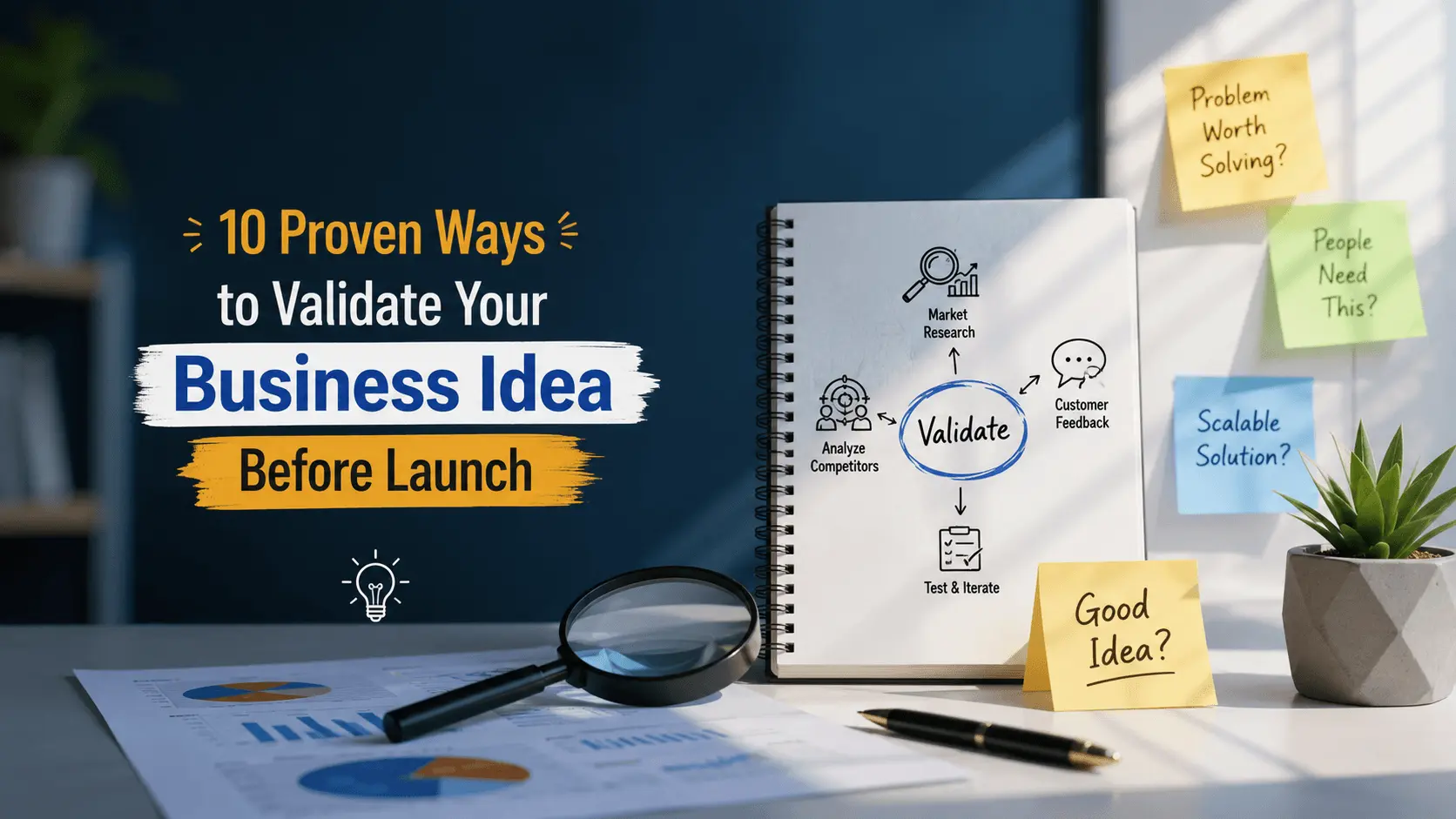
Every year, thousands of entrepreneurs launch businesses built on excitement instead of evidence. About 90% of startups eventually fail, and nearly 42% of those failures trace back to one root cause: no real market need. That single number explains why business idea validation matters more than almost any other early-stage decision. Knowing how to validate a business idea before investing can mean the difference between a product people fight to buy and one nobody wants.
A good idea feels exciting in your head. A validated business opportunity is different. It has real customers, real feedback, and real proof that people will pay for it. Startup idea validation closes that gap. It replaces guesswork with evidence, so you invest money into something the market has already told you it wants.
Validation also protects your finances. Building a full product before testing demand is expensive and risky. Founders who skip this step often spend months, sometimes years, on features nobody asked for. A structured business validation process catches these mistakes early, while they are still cheap to fix.
This guide walks you through 10 proven ways to validate your business idea before launch. You will learn how to research your market, talk to real customers, test pricing, and read the results honestly. These are practical business startup tips you can apply this week, not abstract theory.
Key Takeaways
Validation reduces financial risk by testing demand before you build.
Real customer feedback beats assumptions and guesswork every time.
Search demand, landing pages, and paid ads reveal genuine interest fast.
Willingness to pay is the strongest proof your idea has value.
A simple checklist helps you decide whether to proceed, improve, pivot, or stop.
Why Business Idea Validation Matters
Skipping validation is one of the most expensive mistakes a founder can make. Without it, you are building on assumptions instead of facts. A solid business validation process forces you to test those assumptions before spending real money on development, inventory, or marketing.
Validation also saves time. Instead of spending a year building a product nobody wants, you can spend a few weeks testing the idea directly with real people. This faster feedback loop lets you fail cheaply, learn quickly, and redirect your effort toward what actually works.
Understanding customer demand is another major benefit. When you validate early, you learn exactly what your audience struggles with and how much they are willing to pay to fix it. This insight shapes a product that people genuinely want, rather than one you simply hope they will want.
Finally, validation builds investor confidence. A business feasibility analysis backed by real customer data is far more persuasive than a pitch built on opinion. Investors want proof, not enthusiasm. This entrepreneurship guide focuses on getting that proof before you need it most.
What Does It Mean to Validate a Business Idea?
To validate a business idea means testing your assumptions against real-world evidence before committing serious resources. It is the process of confirming that a genuine problem exists, that people want your solution, and that they are willing to pay for it.
Market validation examines several factors at once. You need proof of demand, meaning enough people actually experience the problem you plan to solve. You need to understand your competition, since a crowded market can signal both opportunity and risk. Pricing matters too, because a product only succeeds if customers see its value as worth the cost.
Scalability is another piece of the puzzle. A validated business concept should work for more than a handful of early adopters. It needs a path to grow without breaking the underlying business model.
When you validate a business concept properly, you move from hoping people will buy to knowing they already want to. That shift is the entire point of the process.
The Difference Between an Idea and a Validated Business Opportunity
A business idea starts as a hunch. It usually comes from a personal frustration, an observation, or a flash of inspiration. On its own, an idea is just an assumption waiting to be tested. It has not yet earned any proof.
A validated business opportunity is different. It rests on proven demand instead of opinion. It reflects customer feedback instead of guesswork. Most importantly, it relies on data-driven decisions rather than gut feeling alone.
This distinction matters because of risk. An unvalidated idea carries high risk, since nobody has confirmed that customers actually want it. A validated opportunity carries lower risk, because real people have already shown interest, whether through interviews, sign-ups, or actual purchases.
Evidence is the bridge between the two. Every method in this guide exists to help you gather that evidence, so you invest with confidence instead of hope.
10 Proven Ways to Validate Your Business Idea Before Launch
1. Identify a Real Problem Worth Solving
Every strong business starts by solving a real, painful problem. If the problem is minor or rare, customers will not bother switching from what they already do. Business idea research begins with finding pain points that are urgent, frequent, and expensive to leave unsolved.
Start by studying existing solutions in the market. Look closely at what current products do well and where they fall short. Gaps between what customers need and what is currently offered often point directly to your opportunity.
Online communities are a goldmine for this kind of research. Forums, Reddit threads, and Facebook groups are full of people openly complaining about unmet needs. Reading these conversations gives you unfiltered, honest insight into real frustrations.
Customer reviews on competitor products offer the same value. Pay close attention to one-star and two-star reviews, since these often reveal exactly where existing solutions disappoint users. Conducting a handful of informal interviews adds even more depth. Customer validation starts here, with genuine listening before you build anything.
2. Define Your Target Audience
You cannot validate an idea for everyone. A clearly defined target audience makes every later validation step sharper and more useful. Startup market research always begins with knowing exactly who you are trying to serve.
Build a simple customer persona to guide your thinking. Include age range, income level, job type, and daily habits relevant to your product. This persona becomes a reference point every time you test messaging, pricing, or features.
Demographics only tell part of the story. Buying behavior matters just as much, including how your audience researches purchases and what convinces them to say yes. Understanding these patterns helps you predict how they will respond to your offer.
Needs and motivations tie everything together. People buy products to solve problems or reach goals, not simply because a product exists. Market research for startups works best when it uncovers these deeper motivations behind every purchase decision.
A clear audience improves every other validation method in this guide. Interviews become sharper, ads become cheaper, and landing pages convert better once you know exactly who you are speaking to.
3. Research Your Competitors
Competitor research reveals what already works and what customers still wish existed. Direct competitors sell nearly the same solution you are considering. Indirect competitors solve the same underlying problem through a different method or product entirely.
Study their pricing models closely. Notice whether competitors charge one-time fees, subscriptions, or tiered plans based on usage. This tells you what your future customers already expect to pay, and where price sensitivity might exist.
Customer reviews of competing products are equally valuable here. Complaints reveal weaknesses you can improve on, while praise reveals features you must match or exceed. Both extremes teach you something useful about the market.
Look for a genuine competitive advantage before committing further. This could be better pricing, superior service, or a feature nobody else offers yet. If you cannot identify a clear edge, that is important information too, and worth addressing before you invest more.
Competitor research often reveals real market opportunities hiding in plain sight. Underserved segments, ignored complaints, and pricing gaps all point toward openings a new business could fill.
4. Conduct Customer Interviews and Surveys
Direct conversations with potential customers remain one of the most reliable validation methods available. Business idea testing through interviews uncovers details that data alone cannot show, including tone, hesitation, and genuine excitement.
Ask open-ended questions instead of leading ones. Instead of asking "would you buy this," ask how they currently solve the problem and what frustrates them about it. This approach avoids flattering answers and surfaces honest, useful insight.
Avoiding bias is critical throughout this process. People often say what they think you want to hear, especially friends and family. Speaking with strangers who match your target audience produces far more trustworthy customer validation.
Sample questions worth asking include: What is the hardest part of dealing with this problem today? What have you already tried, and why didn't it work? How much would solving this be worth to you?
Collect these answers systematically, whether through short surveys or recorded interviews. Patterns across ten or more conversations carry far more weight than a single enthusiastic response.
5. Validate Search Demand with Keyword Research
Search behavior reveals what people are actively trying to solve right now. Market validation through keyword research shows whether your idea matches existing demand or whether you would need to create demand from scratch.
Google Trends is a simple starting point. It shows whether interest in your topic is rising, falling, or holding steady over time. A steady or growing trend line is a positive early signal.
Search volume data adds more detail. Tools that show monthly search numbers help you estimate how many people are actively searching for solutions like yours. Low volume is not always bad, but it does change your growth expectations.
Long-tail keywords often reveal the clearest intent. Phrases like "how to validate a business idea before investing" show someone actively researching a solution, not just browsing casually. This is exactly the kind of business idea research that predicts real demand.
Search intent matters as much as volume. Someone searching to buy differs completely from someone simply researching. Matching your offer to genuine buying intent improves every validation step that follows.
6. Build a Minimum Viable Product (MVP)
An MVP is the simplest version of your product that still delivers real value. It strips away extra features so you can test your core idea quickly and affordably. MVP validation focuses on learning, not on building something polished.
Simplicity matters because speed matters. The faster you can get a basic version in front of real users, the faster you learn whether your core assumption is correct. A perfect product built in isolation teaches you nothing until real people use it.
Early feedback is the entire purpose of an MVP. Watch how people actually use it, not just what they say about it afterward. Behavior often tells a more honest story than opinions do.
Iteration follows naturally from this feedback. Adjust features, messaging, or pricing based on what users actually do. This cycle moves you steadily closer to genuine product-market fit, one small improvement at a time.
An MVP does not need to be a working app. It can be a manual service, a simple prototype, or even a basic spreadsheet tool, as long as it delivers the core value you are testing.
7. Create a Landing Page Before Building the Product
A landing page lets you test interest before writing a single line of product code. Visitors see your value proposition and decide whether to take action, giving you a clear, measurable signal of real interest.
Email signups are the simplest metric to track here. If strangers are willing to hand over their email for early access, that is a meaningful vote of confidence. It shows curiosity strong enough to act on.
Conversion rate tells you how effective your messaging really is. Recent landing page benchmarks show a global average conversion rate of roughly 10.76% across industries, though ecommerce-specific pages often convert lower, closer to 2% to 4%. Comparing your results against these numbers helps you judge whether your offer resonates.
Testing different headlines, pricing hints, or benefit statements shows exactly what messaging performs best. Small wording changes can shift conversion rates significantly, so treat your landing page as an ongoing experiment rather than a finished asset.
A landing page also gauges real interest without any product risk. You are not promising delivery yet. You are simply measuring whether the idea, as described, pulls people toward action.
8. Run Small Paid Marketing Campaigns
Paid ads let you test demand with real strangers, not just friends or existing contacts. Small budgets on Google Ads, Facebook Ads, Instagram Ads, or LinkedIn Ads can validate interest within days instead of months.
Click-through rate shows how compelling your ad copy and image are at first glance. A low click-through rate usually signals weak messaging rather than weak demand, so test several variations before concluding.
Cost per lead tells you whether your customer acquisition is financially realistic. If leads cost more than a customer could ever be worth, that is a warning sign worth addressing before scaling any further.
Conversion rate closes the loop between clicks and actual signups or purchases. This number, combined with cost per lead, tells you whether paid demand generation could realistically support your business model long term.
Paid campaigns validate demand quickly because they scale with strangers, not just your personal network. A small, well-targeted test budget often reveals more truth in a week than months of casual conversation ever could.
9. Test Pricing and Willingness to Pay
Positive feedback feels encouraging, but paying customers provide far stronger validation. Pricing experiments reveal whether people value your solution enough to actually spend money on it, not just praise it in conversation.
Pre-orders are one of the clearest signals available. Asking someone to pay before the product exists filters out polite interest from genuine commitment. Even a small number of pre-orders carries real weight.
Early access offers work similarly. Charging a modest fee for priority access tests both interest and urgency at the same time. People willing to pay early are showing you real conviction, not just curiosity.
Discounts and limited-time offers can also test price sensitivity. Watch how demand shifts as you adjust the price point up or down. This tells you where perceived value actually sits in your customers' minds.
Value perception ties everything together. A product priced too low can seem unconvincing, while one priced too high may exceed what customers believe it is worth. Testing pricing directly removes the guesswork from this balance.
10. Analyze the Results Before Investing Further
Once you have gathered data from interviews, landing pages, ads, and pricing tests, it is time to interpret it honestly. Business feasibility analysis means looking at the evidence clearly, even when it contradicts what you hoped to hear.
Start with customer feedback patterns. Are the same problems and requests showing up repeatedly across different people? Repetition across strangers is far more meaningful than a single enthusiastic comment.
Review your conversion rates next, comparing landing page signups, ad performance, and pre-order numbers against realistic industry benchmarks. Retention potential matters too, since a one-time purchase is very different from a product people want to use again.
Market size and revenue projections round out the picture. Even strong early interest needs to scale into a large enough audience to sustain a real business over time.
Use a simple decision framework to guide your next move: Proceed if the evidence is strong and consistent. Improve if the core idea works, but execution needs refinement. Pivot if feedback points toward a different problem or audience. Abandon if the data shows no real demand, even after multiple tests.
Business Idea Validation Checklist
Use this checklist to confirm you have covered every major validation step before investing further.
Validation Question | Yes | No |
Real customer problem identified |
|
|
Target audience defined |
|
|
Competitor analysis completed |
|
|
Customer interviews conducted |
|
|
Search demand verified |
|
|
MVP created |
|
|
Landing page tested |
|
|
Paid ads validated demand |
|
|
Customers willing to pay |
|
|
Positive market feedback received |
|
|
If most answers are yes, your business validation process supports moving forward. If several boxes remain unchecked, that is a clear signal to keep testing before you invest further. This checklist works as a fast reference every time you consider a new idea to validate a startup idea.
Common Business Idea Validation Mistakes
Falling in love with your idea is one of the most common traps founders fall into. Once emotionally attached, it becomes tempting to ignore warning signs and interpret every response as encouraging, even when the data says otherwise.
Ignoring customer feedback compounds this problem. Founders sometimes hear criticism and dismiss it as the customer simply not understanding the vision. In reality, unclear messaging or a weak product usually explains the confusion far better.
Building too much too early wastes both time and money. Startup idea validation exists precisely to prevent this by testing core assumptions before committing to full development.
Skipping market research entirely leaves founders guessing where they should be measuring. Relying only on friends and family compounds the issue further, since people close to you rarely give fully honest feedback.
Assuming demand without evidence is the root cause behind most of these mistakes. These business startup tips exist to replace assumptions with proof, so your next launch rests on something firmer than optimism alone.
Best Business Name Generator
A strong business starts with a memorable and professional name. Your business name shapes first impressions, supports your branding, and helps customers recognize and remember your company. Whether you're validating a new startup idea or preparing to launch, choosing the right name is an important step that shouldn't be overlooked.
Ai Bizname is a free AI-powered Business Name Generator designed to help entrepreneurs, startups, and small business owners discover creative, unique, and industry-relevant business names in seconds. Simply enter your niche, select your preferred naming style, and provide a few details about your business to receive hundreds of tailored name suggestions. This makes the brainstorming process faster and more effective.
Using AI Bizname can save valuable time during the planning stage while inspiring fresh branding ideas that align with your business goals. Whether you're testing a new concept, creating an MVP, or preparing for a full-scale launch, AI Bizname provides an easy, user-friendly solution for finding a distinctive business name that supports long-term growth and brand recognition.
Business Validation Tools and Resources
The right tools make each validation step faster and more accurate. Below are proven resources entrepreneurs rely on throughout the process.
Google Trends: Tracks search interest over time to confirm rising or steady demand.
Google Keyword Planner: Reveals search volume and competition for your target keywords.
SurveyMonkey: Builds structured surveys for collecting customer feedback at scale.
Typeform: Creates engaging, conversational surveys with strong completion rates.
Hotjar: Shows heatmaps and recordings of how visitors interact with your landing page.
Canva: Designs quick, professional visuals for ads, landing pages, and surveys.
ChatGPT: Speeds up interview question drafting, survey design, and messaging tests.
Product Hunt: Introduces early products to an audience actively seeking new tools.
Reddit: Surfaces honest, unfiltered discussions about real customer pain points.
LinkedIn: Connects founders directly with target customers for interviews and feedback.
Crunchbase: Provides competitor and market data to support feasibility analysis.
Each tool supports a different stage of validation, from early research through pricing tests. Combining a few of these resources gives you a well-rounded, evidence-based view of your idea before you invest further.
Conclusion
Every successful business starts with validation, not assumptions. The founders who avoid costly failure are the ones who test their ideas before betting everything on them. Real evidence, not hope, separates a passing idea from a lasting business.
Focus on solving real customer problems first, and gather proof before making any major investment. Market research, customer interviews, MVP testing, and pricing experiments all work together to reduce risk and build genuine confidence in your direction.
With AI adoption accelerating across small businesses and ecommerce, and a growing share of retailers using AI in daily operations, tools for testing ideas have never been more accessible. There has never been a better time to quickly and affordably validate a business idea.
Validate first, then invest. This order builds a business with a real chance at long-term success, instead of one built on guesswork alone. Apply these ten validation methods to your next idea before you launch, and let evidence guide every decision that follows.
Frequently Asked Questions
Why is business idea validation important?
Validation confirms real demand before you invest time and money. It reduces financial risk, reveals what customers actually want, and helps you avoid building a product nobody needs.
How do I validate a business idea without spending much money?
Use free tools like Google Trends, customer interviews, and social media research. Landing pages and small surveys also validate demand without requiring a built product.
What is the fastest way to test a startup idea?
A landing page paired with a small paid ad campaign is often fastest. It measures real interest within days through signups, clicks, and conversion data.
How many customer interviews should I conduct?
Ten to fifteen interviews usually reveal clear, repeating patterns. Fewer conversations may not show consistent themes across your target audience.
What is an MVP, and why is it important?
An MVP is the simplest version of your product that still delivers core value. It lets you test assumptions quickly, before investing in full development.
How do I know if there is market demand?
Look for repeated search volume, active online discussions, and willingness to pay. Multiple independent signals pointing the same direction confirm genuine demand.
What is product-market fit?
Product-market fit means your product satisfies a strong market demand effectively. Customers actively want it, use it repeatedly, and recommend it to others.
Can I validate a business idea before building the product?
Yes, through landing pages, surveys, interviews, and pre-orders. These methods measure real interest and willingness to pay before development begins.
What are the biggest business validation mistakes?
Common mistakes include ignoring negative feedback and skipping market research. Relying only on friends and family also leads to overly optimistic, unreliable results.
How long does business idea validation usually take?
Most validation processes take two to six weeks. Timing depends on how quickly you can gather interviews, test ads, and analyze landing page data.