

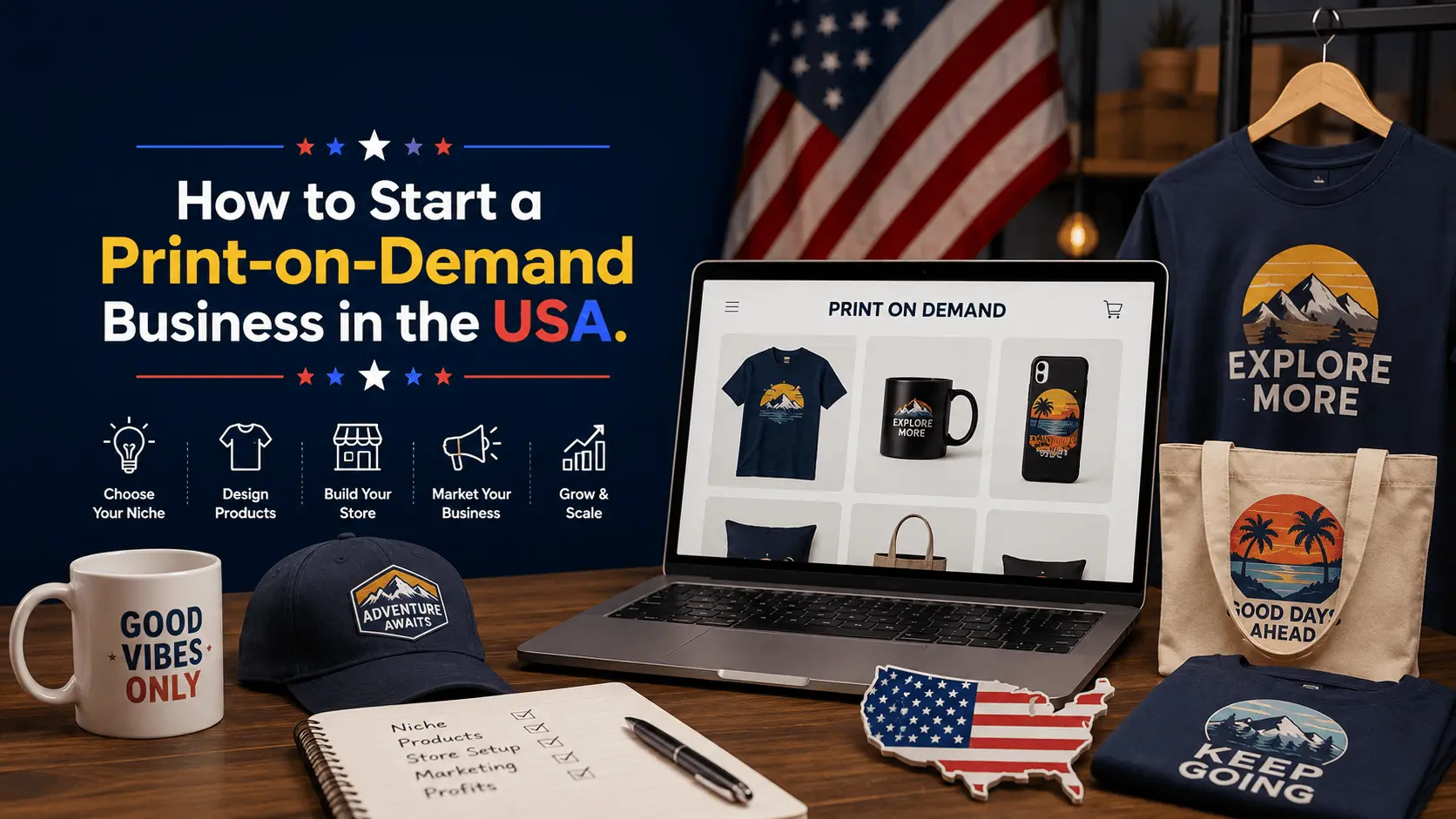
Starting a print-on-demand business is one of the easiest ways to launch an online store without holding inventory. If you want to start a print-on-demand business in the USA, this guide walks you through every step. The print-on-demand business market in the USA keeps growing each year, giving new sellers real room to build profitable stores.
Many startup owners struggle with unclear costs, confusing suppliers, and weak marketing plans. This guide solves those pain points with clear, practical answers. You will learn how to start a print-on-demand business from home, choose a niche, pick suppliers, and price your products correctly.
We also cover print-on-demand for beginners topics like design tools, store setup, and basic U.S. tax rules. By the end, you will have a full roadmap for launching a print-on-demand store that earns steady income. Whether you plan to sell through Etsy print-on-demand or build a Shopify print-on-demand store, the steps here apply to both.
This is not a promotional post. It is a practical playbook built for real startup owners who want results, not hype.
Key Takeaways
Starting a POD business costs as little as $50 to $500, far less than traditional retail startups.
The U.S. print-on-demand market is growing fast, with strong projected growth through 2034.
Etsy and Shopify remain the two strongest platforms for a print-on-demand store in the USA.
Picking one focused niche outperforms selling generic designs to everyone.
AI tools now help sellers create designs, write listings, and answer customer questions faster than ever.
Supplier quality directly affects print accuracy, shipping speed, and customer reviews.
Simple designs with one or two elements tend to convert better than cluttered artwork.
Scaling a POD business depends on steady product testing and smart marketing, not luck.
What Is a Print-on-Demand Business?
A print-on-demand business is a model where you sell custom products without buying inventory first. A supplier only prints your design after a customer places an order. This removes upfront stock costs and storage worries completely.
It is one of the simplest POD business ideas for people who want to start small. You focus on design, branding, and marketing. The supplier handles printing, packing, and shipping on your behalf.
This setup makes the print-on-demand business model attractive for first-time entrepreneurs. You can test dozens of product ideas without risking money on bulk inventory. If a design does not sell, you simply remove it from your store.
Print-on-demand differs from dropshipping in one key way. Dropshipping usually sells generic, mass-produced items sourced from other sellers. Print-on-demand focuses on original, custom designs printed on blank products you choose yourself.
This difference matters for branding. A print-on-demand store can build a real identity around unique art and messaging. That identity is much harder to copy than a generic dropshipping catalog, which gives your store a longer-term competitive edge.
How Does Print-on-Demand Work?
Understanding how print-on-demand works helps you avoid early mistakes. The process is simple once you see each step in order. Here is what happens behind every POD sale.
A customer visits your store and places an order for a custom product.
Your store automatically sends the order details to your print-on-demand supplier.
The supplier prints the design, packs the item, and ships it directly to the customer.
You keep the profit margin between your retail price and the supplier's base cost.
You never touch the physical product in most cases. This hands-off fulfillment is why so many startup owners choose print-on-demand for beginners over traditional retail.
Most POD suppliers connect to your store through a simple app integration. Once connected, new orders sync automatically without manual entry. This automation is what allows a single founder to run a full print-on-demand store from home, even alongside a full-time job.
Why Start a POD Business in the USA?
The U.S. market gives new sellers a strong reason to start now. According to print-on-demand market data, the U.S. print-on-demand market was valued near $3.23 billion in 2025 and is expected to keep climbing through the next decade.
North America also holds the largest regional share of the global print-on-demand market. This means U.S. sellers already sit inside the biggest buyer pool. Strong logistics networks and fast domestic shipping add another advantage for local sellers.
U.S. shoppers also spend heavily on personalized and custom gifts throughout the year. Holidays, birthdays, and life events all drive steady demand for custom products. This gives a print-on-demand business from home consistent order flow across the calendar.
AI tools have also lowered the skill barrier for new sellers. Design generators, listing writers, and chatbots now handle tasks that once required a full team. This makes 2026 one of the most accessible years yet to start a print-on-demand business.
Consumer buying habits are also shifting toward AI-influenced discovery. Shoppers increasingly find products through AI-powered search and recommendation tools instead of traditional browsing alone. Sellers who write clear, keyword-rich product descriptions today are better positioned to appear in these newer discovery channels tomorrow.
Add to this the strength of the U.S. shipping and payment infrastructure. Fast domestic delivery, trusted payment gateways, and buyer protection policies all reduce friction for new customers. This combination of demand, infrastructure, and tooling is why the USA remains one of the strongest markets for POD founders.
Flexibility is another underrated advantage. You can run a print-on-demand business from home around a full-time job, school schedule, or family responsibilities. Orders are processed automatically, so the business does not demand constant, active attention throughout the day.
This flexibility also means you can start small and scale gradually. There is no pressure to quit another income source before testing whether your niche and designs actually sell. Many successful sellers spent months running their store part-time before going full-time.
The low barrier to entry does mean more competition than a decade ago. Standing out now depends more on niche focus, design quality, and consistent marketing than on simply being an early mover. Sellers who treat POD as a real business, not a quick side project, tend to outlast the competition.
How Much Does It Cost to Start a POD Business?
The print-on-demand startup cost is one of the lowest in eCommerce. Most sellers can launch a working store for under $500. Here is a realistic breakdown of common starting expenses.
Store platform subscription: $0 to $39 per month, depending on Etsy or Shopify.
Custom domain name: $10 to $20 per year.
Design software or AI design tools: $0 to $30 per month.
Sample product orders: $30 to $100 for quality testing.
Basic marketing budget: $50 to $200 to start.
Business registration and licensing: $50 to $300, depending on your state.
Unlike traditional retail, you never pay for bulk inventory upfront. This is what makes the POD business model so appealing to first-time founders. You can reinvest profits into marketing as sales grow instead of tying up cash in stock.
Compare this to a typical brick-and-mortar startup, which often requires thousands of dollars in opening inventory alone. A print-on-demand business from home removes that entire cost category. This is one reason POD remains a popular first business for people testing entrepreneurship without major financial risk.
Keep a simple spreadsheet of every expense from day one. Tracking costs early makes tax season easier and helps you see your true profit margin. Many new sellers skip this step, then struggle later to understand where their money actually went.
How to Choose a Profitable POD Niche
Choosing the right niche is the single most important early decision. A focused niche helps you stand out in a crowded market. It also makes marketing much easier since you know exactly who you are targeting.
Look for a niche where real demand meets a gap in current offerings. Avoid niches that are already flooded with generic, low-effort designs. A strong niche balances your personal interest with proven buyer demand.
Check Google Trends to see if interest in your niche is rising or falling.
Search your niche keywords directly inside Etsy to study current competition.
Join Facebook groups or subreddits related to your niche for real customer language.
Look for underserved sub-niches inside popular categories, like pet loss gifts inside pet products.
Confirm the niche can support multiple product types, not just one design idea.
A profitable niche usually solves a specific problem or celebrates a specific identity. Think about hobbies, professions, pet breeds, regional pride, or personal milestones. These angles give you clear messaging for both product descriptions and marketing content.
Avoid switching niches too quickly if early sales feel slow. Give a niche at least a few weeks of consistent effort before judging results. Many stores fail simply because the founder abandoned a good niche too early.
How to Find Print-on-Demand Product Ideas
Great product ideas rarely come from guessing. They come from watching real buyer behavior across multiple channels. Use these sources to build a steady pipeline of new print-on-demand product ideas.
Browse Pinterest trends for rising design styles and color palettes.
Study Etsy bestseller lists inside your chosen niche category.
Watch TikTok and Instagram Reels for viral product formats.
Read customer reviews on competitor listings for unmet needs.
Track upcoming holidays and events at least three months ahead.
Ask your own audience directly through polls or comments.
Combining these sources gives you a mix of proven demand and fresh, less saturated ideas. This is far more reliable than copying whatever is already trending everywhere else.
Keep a running idea list instead of chasing a single concept at a time. Add new ideas whenever you spot them, then review the list weekly. This habit turns product research into a steady process instead of a stressful, last-minute scramble.
Best Print-on-Demand Products to Sell
Some product categories consistently outperform others. Recent market share data shows apparel holds close to 40 percent of the entire print-on-demand market, making it the top category for new sellers.
Beyond apparel, several other product types offer strong profit potential with lower competition. Here are the most profitable POD products to consider for your store.
T-shirts, hoodies, and sweatshirts
Tote bags and canvas bags
Mugs and drinkware
Phone cases
Wall art, posters, and canvas prints
Stickers and decals
Notebooks and journals
Hats and beanies
Pet accessories, including bandanas and blankets
Start with two or three product types instead of listing everything at once. This keeps quality control manageable while you learn what your audience actually buys.
Home decor and drinkware categories have also grown quickly in recent years, driven by rising demand for personalized gifts. Pairing a strong seller like apparel with a smaller add-on category, such as stickers, often increases average order value. Customers frequently add a low-cost item once they are already checking out.
How to Find a Reliable POD Supplier
Your supplier controls print quality, shipping speed, and packaging. A weak supplier can damage your store rating even when your designs are excellent. Always test a supplier personally before listing products publicly.
Order a sample product before adding it to your live store.
Compare shipping times to your target customer locations.
Check product base costs against your planned retail pricing.
Read recent seller reviews about print accuracy and color matching.
Confirm the supplier integrates directly with your chosen platform.
Pay close attention to production location when comparing suppliers. A supplier with U.S.-based printing facilities usually ships faster to domestic customers than one printing overseas. Faster shipping directly improves customer satisfaction and reduces support requests about delayed orders.
Also review each supplier's return and reprint policy before committing. A good supplier reprints misprinted items quickly without heavy back-and-forth. This protects your store rating even when occasional printing errors happen.
Best Print-on-Demand Platforms for the USA
Your platform choice shapes how customers find and buy from you. Some platforms bring built-in traffic, while others give you full control over branding. Here are the best print-on-demand platforms for U.S. sellers.
Shopify
Etsy
WooCommerce
BigCommerce
Squarespace
Most beginners start with either Etsy or Shopify because both connect easily with major POD suppliers. Your final choice depends on whether you want marketplace traffic or full brand ownership.
WooCommerce works well if you already run a WordPress site and want more control over hosting. BigCommerce suits sellers planning to scale into larger catalogs quickly. Squarespace appeals to sellers who value simple, design-forward templates over deep customization.
Top 5 Print-on-Demand Platforms in the USA
Your supplier platform shapes product quality, shipping speed, and profit margin just as much as your store builder does. These five names consistently rank among the most reliable print-on-demand platforms for U.S. sellers. Each one fits a slightly different business style and order volume.
Printful
Printify
Gelato
CustomCat
SPOD
Printful is one of the most established platforms, known for strong print quality and U.S.-based production facilities. It offers built-in mockup tools, warehousing, and branded packaging options. Many sellers choose Printful when print quality and brand presentation matter most.
Printify connects sellers to a large network of print providers instead of running its own factories. This gives you wider product variety and competitive base pricing across categories. Sellers wanting flexibility and lower costs often prefer Printify over single-supplier platforms.
Gelato operates production facilities across many countries, including several U.S. locations, which shortens delivery times. It suits sellers targeting both U.S. and international customers from one store. Local production also reduces shipping costs and delays significantly.
CustomCat focuses on fast turnaround times and a wide apparel selection at competitive pricing. It integrates smoothly with Shopify and Etsy. Sellers prioritizing speed and lower production costs often choose CustomCat for high-volume apparel stores.
SPOD, short for Spreadshirt Print on Demand, specializes in extremely fast production, often within 48 hours. This speed advantage helps sellers compete on delivery promises without holding inventory. SPOD works best for sellers who value quick fulfillment over an expanded product catalog.
Etsy vs. Shopify for POD
This comparison is one of the most common questions from new sellers. Recent Etsy marketplace statistics show the platform still reaches tens of millions of active buyers each year, giving new shops built-in exposure.
Etsy gives you instant access to shoppers already searching for custom and handmade goods. You do not need to build traffic from scratch. However, you share the marketplace with millions of competing sellers and pay listing and transaction fees.
Shopify gives you a fully branded store with no marketplace competition inside your own pages. You control the design, checkout, and customer data completely. The tradeoff is that you must drive your own traffic through marketing and SEO.
Many successful sellers eventually run both. They use Etsy for quick discovery and Shopify for long-term brand building. Starting on Etsy first is often easier for print-on-demand for beginners with a limited marketing budget.
Fees also differ between the two platforms. Etsy charges listing fees plus a transaction percentage on every sale. Shopify charges a flat monthly subscription instead, which can become more cost-effective once your order volume grows steadily.
Think about long-term ownership as well. On Etsy, your shop exists inside Etsy's rules and algorithm changes, which you cannot control. On Shopify, you own your customer list and store data directly, giving you more control over long-term marketing decisions.
How to Create Your POD Designs
Your designs are the actual product customers are buying. Even the best marketing cannot save a weak or generic design. Focus on originality, clarity, and a consistent style across your store.
Use design tools like Canva, Adobe Express, or Kittl for quick, professional results.
Try AI design generators to speed up idea creation and mockup testing.
Keep designs simple, since single-element designs tend to sell best.
Save files as transparent PNGs at high resolution for clean printing.
Always check your design against trademark and copyright rules before publishing.
AI-assisted design tools have made this step far faster than it was even two years ago. You can now generate multiple design variations in minutes instead of hours. This lets small teams compete with much larger POD brands.
Build a simple style guide once you find a design direction that works. Include your preferred fonts, color palette, and general layout rules. A consistent style guide makes your store feel like an established brand rather than a random collection of listings.
Test how each design looks on the actual product, not just on a flat screen. Curved surfaces like mugs and folded items like hoodies can distort designs slightly. Always review supplier mockups closely before publishing a new listing.
How AI Is Changing Print-on-Demand
Artificial intelligence has quietly become a core part of modern eCommerce. Recent AI adoption statistics show that print-on-demand sellers increasingly rely on automated tools for design, pricing, and customer support tasks.
AI design generators now let sellers create original artwork without advanced design skills. You describe a concept in plain language, and the tool produces multiple visual directions. This shortens the gap between having an idea and testing it on a real product.
AI writing tools also speed up product descriptions, ad copy, and social captions. Instead of staring at a blank page, sellers now edit and refine AI-generated drafts. This saves hours each week that can go toward marketing or product research instead.
Customer service is another area seeing rapid change. Simple chatbots now answer common questions about shipping times, sizing, and returns automatically. This frees up your time for higher-value tasks while still giving customers fast responses at any hour.
None of this replaces genuine creativity or strategy. AI works best as a starting point that you refine with your own judgment and brand voice. Sellers who blend AI speed with human taste tend to build the strongest, most memorable stores.
Expect AI tools to keep improving product research as well. Some platforms now suggest trending niches or predict demand based on recent search patterns. Treat these suggestions as a helpful starting point, then confirm demand yourself before investing real time or money.
Best Print-on-Demand Business Name Generators
Naming your store is one of the first real decisions you will make, and it often causes more delay than it should. AI Bizname is a free AI-powered business name generator built to solve exactly this problem, giving entrepreneurs instant, brandable name ideas instead of hours of manual brainstorming.
The tool works by analyzing your keywords, niche, and preferred tone to produce hundreds of tailored name suggestions in seconds. You can adjust style settings, from modern and playful to professional and minimal, until the results match your brand vision. It also checks domain availability instantly, so you know right away which names are ready to register.
For print-on-demand and dropshipping founders, this speed matters. A strong name should feel memorable, fit your niche, and still have an available domain, and checking all three manually can take hours. AI Bizname removes that friction entirely, letting you move from idea to a registered store name in one short session.
How to Build Your Online Store
Building your store is more straightforward than most beginners expect. Focus on a clean layout and clear product information. Follow these steps to launch a functional print-on-demand store.
Choose your platform and register your store name.
Select a simple, mobile-friendly theme.
Connect a POD supplier app to your store.
Upload your designs and generate product mockups.
Write clear product descriptions with sizing and material details.
Set up secure payment processing.
Configure shipping settings based on your supplier's delivery zones.
Test the full buying process yourself before launching publicly. Place a test order and check the checkout flow on both desktop and mobile.
Add basic trust signals before your official launch. Include a clear About page, contact information, and shipping policy. New visitors decide within seconds whether a store feels trustworthy enough to buy from.
Optimize your homepage and top product pages for fast loading speed. Slow pages push visitors away before they even see your designs. Compress images and remove unnecessary apps that can slow your store down over time.
Set up basic analytics before your first sale, not after. Tracking visitors, traffic sources, and conversion rates from day one gives you a clear baseline. You will need this data later to judge whether marketing changes are actually working.
How to Price Print-on-Demand Products
Pricing determines whether your business is actually profitable. Many new sellers price too low and struggle to cover marketing costs. Use a clear formula instead of guessing.
Start with your supplier's base product cost. Add platform fees, payment processing fees, and your desired profit margin. Most profitable POD products carry a margin between 20 percent and 40 percent after all fees.
For example, if a shirt costs $12 from your supplier, a $28 retail price often leaves healthy room for fees and profit. Always recalculate pricing whenever supplier costs or platform fees change.
Avoid competing purely on the lowest price. Undercutting larger competitors usually erases your margin without actually winning loyal customers. Instead, compete on design quality, niche relevance, and a clear brand story that generic sellers cannot copy easily.
Test small price increases occasionally on your best-selling items. A modest increase often has little effect on conversion rate but a large effect on total profit. Track results closely for two to three weeks after any pricing change.
Consider offering simple bundle discounts once you have a few proven products. Pairing a shirt with a matching sticker or mug can raise your average order value quickly. Bundles also feel like better value to customers than single-item purchases.
How to Handle Shipping and Returns
Your supplier usually manages shipping automatically once an order comes in. Still, you remain responsible for customer communication and satisfaction. Clear policies prevent most disputes before they start.
Display estimated production and shipping times clearly on every listing.
Offer replacements for misprinted or damaged items instead of full refunds when possible.
Keep a simple, written return policy visible on your store.
Respond to shipping delay questions quickly to reduce negative reviews.
Since you do not hold inventory, most shipping issues trace back to the supplier, not you. Choose a supplier with strong tracking and clear delivery windows to keep customers informed.
Set expectations early by explaining that custom products need production time before shipping. Most buyers accept slightly longer delivery windows when the reason is clearly explained upfront. Vague or missing timelines cause far more complaints than honest, visible ones.
Basic U.S. Business and Tax Considerations
Setting up your business correctly from the start saves you problems later. Most POD sellers begin as a sole proprietorship or a single-member LLC. An LLC offers personal liability protection as your revenue grows.
Apply for a free EIN from the IRS if you form an LLC.
Track every business expense, including software, samples, and ad spend.
Understand sales tax nexus rules for the states where you sell.
Consider sales tax automation tools to calculate and file correctly.
Set aside funds for quarterly estimated income tax payments.
This section is general information, not legal or tax advice. Speak with a licensed accountant or attorney before making formal business decisions.
Open a separate business bank account as soon as you start making sales. Mixing personal and business finances makes bookkeeping harder and can weaken liability protection under an LLC. A dedicated account also makes tax season significantly less stressful.
How to Market Your POD Business
Marketing is where most POD stores succeed or fail. Recent AI commerce adoption data shows that a large share of online retailers now use AI tools inside their marketing workflow, from content creation to customer targeting.
You do not need a huge budget to market effectively. Consistency across a few channels beats scattered effort across many. Focus on where your specific niche audience already spends time.
Post regularly on Instagram and TikTok using short product videos.
Build an email list from day one and send weekly updates.
Partner with small niche influencers for honest product reviews.
Run targeted paid ads once you know your best-selling designs.
Share behind-the-scenes content about your design process.
Video content performs especially well for print-on-demand marketing right now. Short clips showing a product being printed, packed, or worn tend to earn strong organic reach. This content also builds trust by showing the real process behind each order.
Do not ignore repeat customers once you gain a base of buyers. A simple post-purchase email sequence, offering related products, often costs little but drives meaningful repeat revenue. Retaining existing customers is usually cheaper than acquiring new ones.
Track which marketing channel actually brings paying customers, not just likes or views. A channel with high engagement but low sales may not deserve more of your time. Redirect effort toward whatever channel shows real, measurable revenue.
Print-on-Demand SEO Strategies
SEO drives free, ongoing traffic to your listings over time. Both Etsy and Shopify reward clear, keyword-rich product pages. Treat SEO as a core part of your launch, not an afterthought.
Research keywords buyers actually type, not just design terms you like.
Place your main keyword in the product title and first sentence.
Write descriptive alt text for every product image.
Use all available tags and categories on Etsy listings.
Publish blog content that answers real customer questions.
Good SEO compounds over months. A well-optimized listing can keep generating sales long after the initial launch push ends.
Update older listings periodically instead of only optimizing new ones. Refresh titles, tags, and images as you learn which keywords actually drive clicks. Small, ongoing adjustments often outperform a single, one-time optimization effort.
Write for real people first, then adjust for search engines. Listings stuffed with repeated keywords read poorly and often convert worse despite ranking well. A natural, benefit-focused description usually performs better across both search ranking and actual sales.
How to Get Your First Customers
Your first sales build confidence and early reviews. Reviews then help convince future buyers to trust your store. Focus your first two weeks on generating initial momentum.
Ask friends and family to share your launch on social media.
Offer a small limited-time discount for your first customers.
Post inside niche Facebook groups or subreddits, following each group's rules.
Send free or discounted samples to small niche content creators.
Engage directly in comments on trending posts within your niche.
Early customers matter more for feedback than profit. Use their responses to refine your designs, pricing, and product descriptions.
Ask satisfied early buyers directly for an honest review. Reviews build the social proof that convinces hesitant shoppers to complete their first purchase. A handful of genuine, detailed reviews often outperforms a large number of vague ones.
Common POD Mistakes to Avoid
Many new sellers repeat the same avoidable mistakes. Knowing these ahead of time saves both money and momentum.
Skipping niche research and copying random trending designs.
Publishing product mockups without ordering a real sample first.
Pricing products too low to leave any real profit margin.
Using cluttered designs with too many colors or elements.
Ignoring SEO and relying only on paid ads for traffic.
Launching with no clear brand name, logo, or visual style.
Choosing a supplier based only on price, ignoring quality reviews.
Trying to sell every niche and product type inside one unfocused store.
Neglecting customer service messages during the first critical weeks after launch.
Most of these mistakes come from moving too fast without testing. Slowing down slightly during your first month often saves far more time later. A careful, deliberate launch tends to outperform a rushed one over the long run.
Watch closely for signs of burnout as well. Publishing dozens of untested products at once often leads to wasted effort and confused branding. A slower, more focused pace usually produces better long-term results than an overwhelming initial rush.
How to Scale a Print-on-Demand Business
Once your store shows steady sales, focus shifts toward scaling. Growth comes from testing more products and improving what already works. Avoid expanding too fast before your core offers are proven.
Add new products consistently instead of relaunching the whole store.
Expand to a second platform once your first store is stable.
Use AI tools to speed up design variations and product copywriting.
Build email automation flows for abandoned carts and repeat buyers.
Outsource design or customer service once order volume grows.
Sustainable scaling depends on data, not guesswork. Track which designs, price points, and channels actually drive profit before increasing your marketing spend.
Consider building a simple product line around your bestsellers instead of scattering effort across unrelated designs. A tight, recognizable collection helps repeat customers recognize your brand instantly. This consistency becomes a real competitive advantage as your store matures.
Explore adding complementary sales channels once your core store is stable. Selling through a marketplace, a social media shop, and your own website at the same time spreads exposure across more potential buyers. Just make sure your inventory feed and pricing stay consistent across every channel.
Consider seasonal planning as another scaling lever. Build holiday and event-specific collections at least two months ahead of the date. Early planning gives you time to test designs, order samples, and build marketing content before demand actually peaks.
Revisit your supplier relationships as order volume increases. Some suppliers offer better bulk pricing or priority production once you reach certain volume thresholds. Renegotiating terms periodically protects your margin as your print-on-demand business grows.
Reinvest a portion of every profitable month back into the business. Whether that means better photography, paid ads, or new product samples, steady reinvestment compounds over time. Businesses that reinvest consistently tend to outgrow those that treat every dollar of profit as personal income too early.
Finally, protect your time as the business grows. Automate repetitive tasks wherever possible and consider outsourcing tasks that do not require your personal judgment. This lets you focus on strategy, new products, and the decisions that actually move your print-on-demand business forward.
Conclusion
You now have a complete roadmap to start a print-on-demand business in the USA. This model removes the biggest barrier in traditional retail, which is upfront inventory cost. With the right niche, supplier, and platform, your print-on-demand store can grow into a real, sustainable income source.
Focus first on one niche, one platform, and a small set of profitable POD products. Test, learn from real customer data, and improve steadily instead of chasing every trend. Print-on-demand for beginners works best when built one careful step at a time, not rushed all at once.
Revisit this guide as your store grows past its first few months. Pricing, marketing, and supplier decisions all evolve as you gather real sales data. The fundamentals covered here remain useful whether you are placing your first order or your thousandth.
Frequently Asked Questions
How much money do I need to start a print-on-demand business?
Most sellers start with $50 to $500. This covers platform fees, sample orders, and basic marketing, since you never pay for bulk inventory upfront.
Is Etsy or Shopify better for print-on-demand?
Etsy offers built-in traffic, while Shopify gives full brand control. Many sellers start on Etsy, then add Shopify once they build a loyal customer base.
Do I need a business license to sell print-on-demand products?
Requirements vary by state. Many sellers start as a sole proprietorship, then form an LLC once sales grow. Check your local state rules for specifics.
What are the most profitable print-on-demand products?
Apparel, mugs, tote bags, wall art, and stickers consistently perform well. Profitability depends more on niche fit and pricing than the product type alone.
Can I run a print-on-demand business from home?
Yes. Since suppliers handle printing and shipping, you only need a computer and internet connection to manage designs, orders, and customer service.
How long does it take to become profitable with POD?
Many sellers see first sales within weeks, but consistent profit often takes three to six months of testing products, pricing, and marketing channels.