

Naming a restaurant is a strategic decision, not just a witty sign. Your chosen words appear on every surface: signage, menus, reservations, delivery apps, and search results. They must be easy for people and the AI assistants they trust to find and repeat. In the next seven steps, you will define your concept, use AI to widen the idea pool, test and clear the finalists, then turn the winner into a brand and a smooth local launch. This guide is educational, not legal advice.
1. Why your restaurant’s name matters before opening day
The name becomes an operating asset.
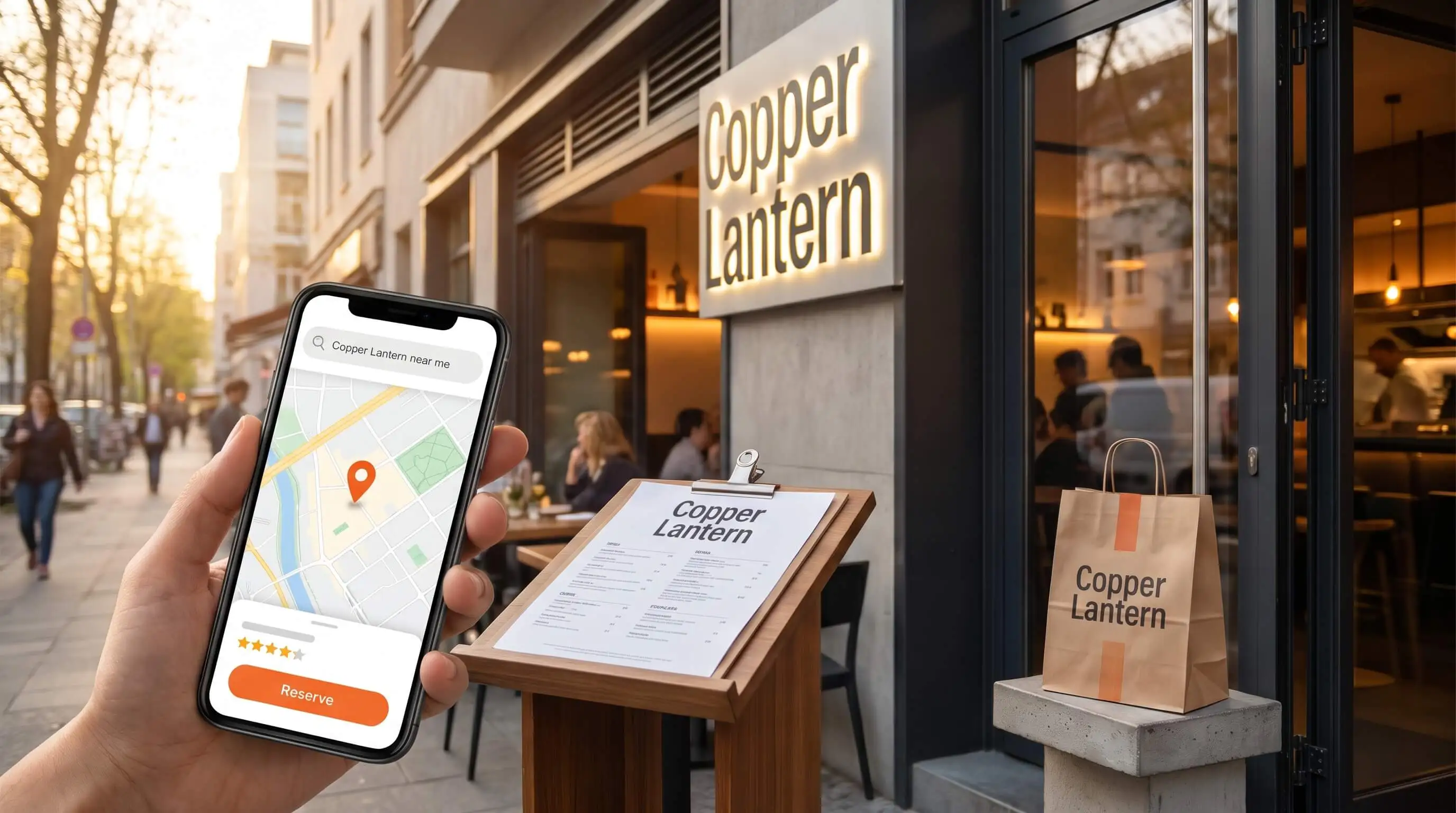
Guests encounter your name on the sign, the menu, delivery bags, and in every search query they run. When the wording is clear and consistent, people, and the AI assistants they rely on, can find you, book you, and recommend you in seconds.
A late change drains cash and momentum.
A restaurant that finds a near-match trademark days before opening can face a cease-and-desist letter and pay again for signs, merchandise, and marketing. Worse, early buzz vanishes as press links and followers point to a brand that no longer exists.
Freeze the name before real money moves.
Set a “name freeze” date. Only after your shortlist clears trademark, domain, state, and local checks should you approve signage, print menus, and claim your Google Business Profile under the exact storefront wording: a match Google requires for eligibility. This brief pause safeguards the budget and keeps every contractor on the same page.
2. What makes a strong restaurant name
A strong restaurant name sets clear expectations, stays memorable, and stands up legally. Branding agencies that anchor early naming work in voice-of-customer interviews start by pulling phrases straight from diner feedback to draft that positioning sentence. That single line becomes the lens for judging every candidate.
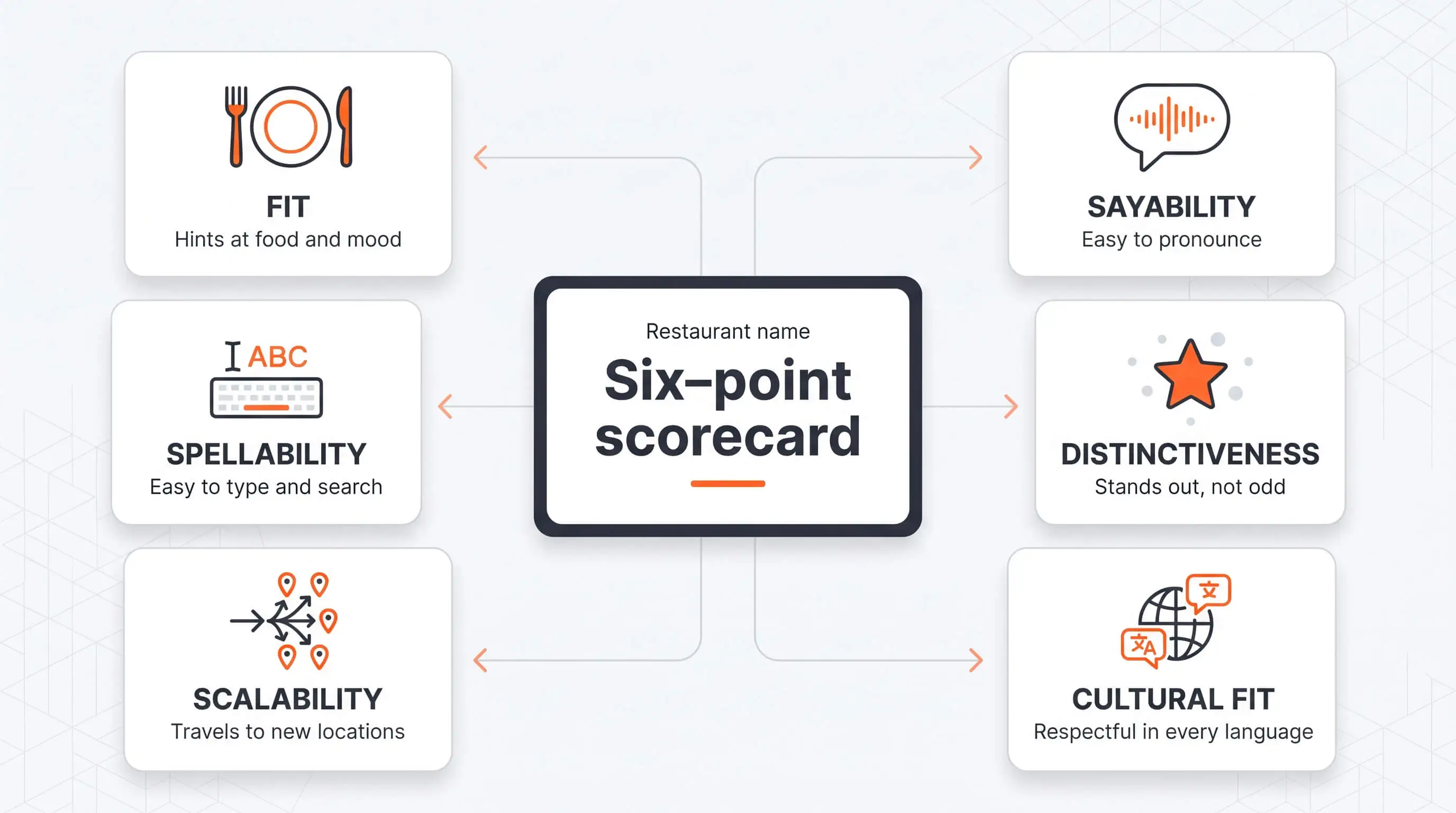
Run a six-point scorecard
Fit: Does it hint at the food and mood?
Sayability: Can guests pronounce it after one glance?
Spellability: Will they type it correctly when booking?
Distinctiveness: Does it lodge in memory without feeling odd?
Scalability: Will it travel to a second location or a product line?
Cultural fit: Are the words accurate and respectful in every language you will use?
Names that meet all six tests usually fall into the suggestive, arbitrary, or fanciful tier. The United States Patent and Trademark Office calls these “inherently distinctive,” making them easier to protect than merely descriptive wording (USPTO guidance).
Stress-test the finalists
Say each name aloud on the phone, then ask a friend to find it on Maps. Print it large, tape it to a window, and read it from across the street after dark. Sleep on the list and note which options you still remember at breakfast. Finally, picture the logo on a jar of house-made sauce or on a hoodie in another city. If the name still feels right, and you can say, spell, and scale it, you are ready to bring AI into the creative sprint.
3. Using AI tools to spark and shape your name ideas
A blank page can stall momentum, but a well-prompted language model can offer dozens of angles in seconds. Give the AI a tight brief, run several distinct “creative lanes,” and keep humans in charge of the short list.
Build a focused AI brief.
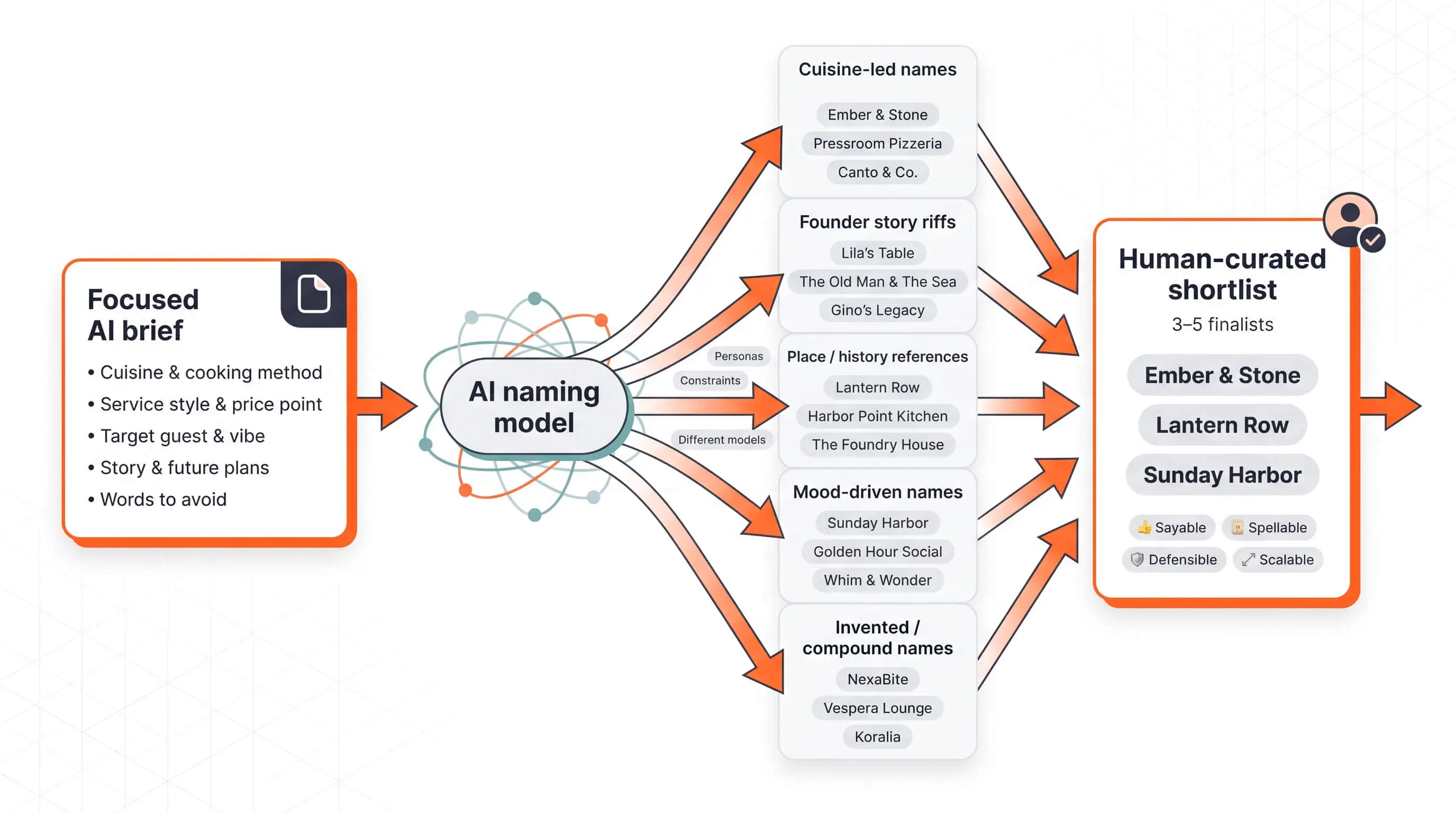
Feed the model one concise paragraph covering cuisine, cooking method, service style, price point, target guest, desired vibe, founder or location story, plans (catering, merch, second site), and any words or puns you refuse. This context keeps suggestions on-brand instead of generic.
Generate in separate directions.
Run at least five batches:
Cuisine-led ideas
Founder-story riffs
Place or history references
Mood or feeling words
Invented or compound names
Splitting prompts this way prevents 50 near-identical taco puns.
Force variety on purpose.
Large models converge unless you shake them up. After each batch, switch the persona (for example, food historian vs. street-art poet), adjust temperature, or change the word-count limit. Studies show varied prompts increase idea diversity without hurting quality.
Trim to a human short list.
Copy every candidate into a sheet and strike anything hard to say, spell, defend, or scale. Combine the survivors with staff or customer ideas until you have three to five finalists ready for the legal checks in Section 4.
Link to the generator, but keep the lawyer.
Drop your brief into an AI business-name generator to speed the brainstorm. Then run the availability checks that follow, because the tool does not clear trademarks or guarantee domains.
Treat AI as a sleepless brainstorming partner, not the final decision maker. When humans curate the results, you gain speed and strategic fit.
Build a richer prompt.
Include nine quick data points so the AI understands both boundaries and creative latitude:
Cuisine and primary cooking method
Service style (full service, fast casual, food truck)
Price point and target guest
Desired emotional tone (for example, cozy or celebratory)
Founder or location backstory
Signature ingredient or dish
Words, puns, or cultural references to avoid
Plans, such as catering or a second site
Languages that need translation checks
Research indicates that clearly scoped prompts yield more relevant ideas and reduce repetitive output. Here is one paragraph you can paste into any generator:
“We’re opening a mid-priced, wood-fired Neapolitan pizzeria in Austin. Our vibe is relaxed but design-forward. Guests are young professionals who love weekend live music. The space was once a 1920s printing press. Avoid Tuscan clichés and the word ‘slice.’ We may can our house marinara and add a second location. Suggest five evocative names plus a short rationale for each.”
This structure gives the model enough detail to stay on brand while leaving room for surprise.
Generate in clear directions.
Ask for ideas in at least five separate lanes so the model can pivot instead of piling on one joke:
Cuisine-led names
Founder or family story spins
Place or neighborhood references
Mood-driven or evocative words
Invented or compound constructions
Prompt variety keeps you from seeing 50 taco puns and surfaces angles you might never brainstorm on your own.
Force diversity on purpose.
Language models converge fast, so shake them up in three deliberate ways:
Switch personas. Prompt once as a food historian, then as a street-art poet.
Vary constraints. Change temperature, word limit, or ask for rhyming versus non-rhyming names.
Mix models. Run the same brief through a second LLM to surface fresh angles.
Varied prompts and parallel searches widen the idea pool without lowering quality.
Trim to a human shortlist.
Paste every candidate into a sheet, strike anything hard to say, spell, protect, or scale, then merge in staff or customer favorites. Aim for three to five finalists, read them aloud, and see which ones you still love after a night’s sleep.
Bring the ideas into your workflow.
After you refine the brief, drop it into a free AI business-name generator as a fresh prompt for each creative lane. The tool returns names plus a moment-in-time domain snapshot, but it does not clear trademarks. Those checks land in Section 4.
AI is the tireless brainstormer, and you are the editor who turns raw ideas into a brand that stands up in the real world.
4. Checking availability before you commit
A name is only yours if no one else can claim it in court, online, or across town. Work through five distinct checks: local web search, domain and handles, state filings, federal trademarks, and Google Business Profile. Follow that order before you print a single menu.
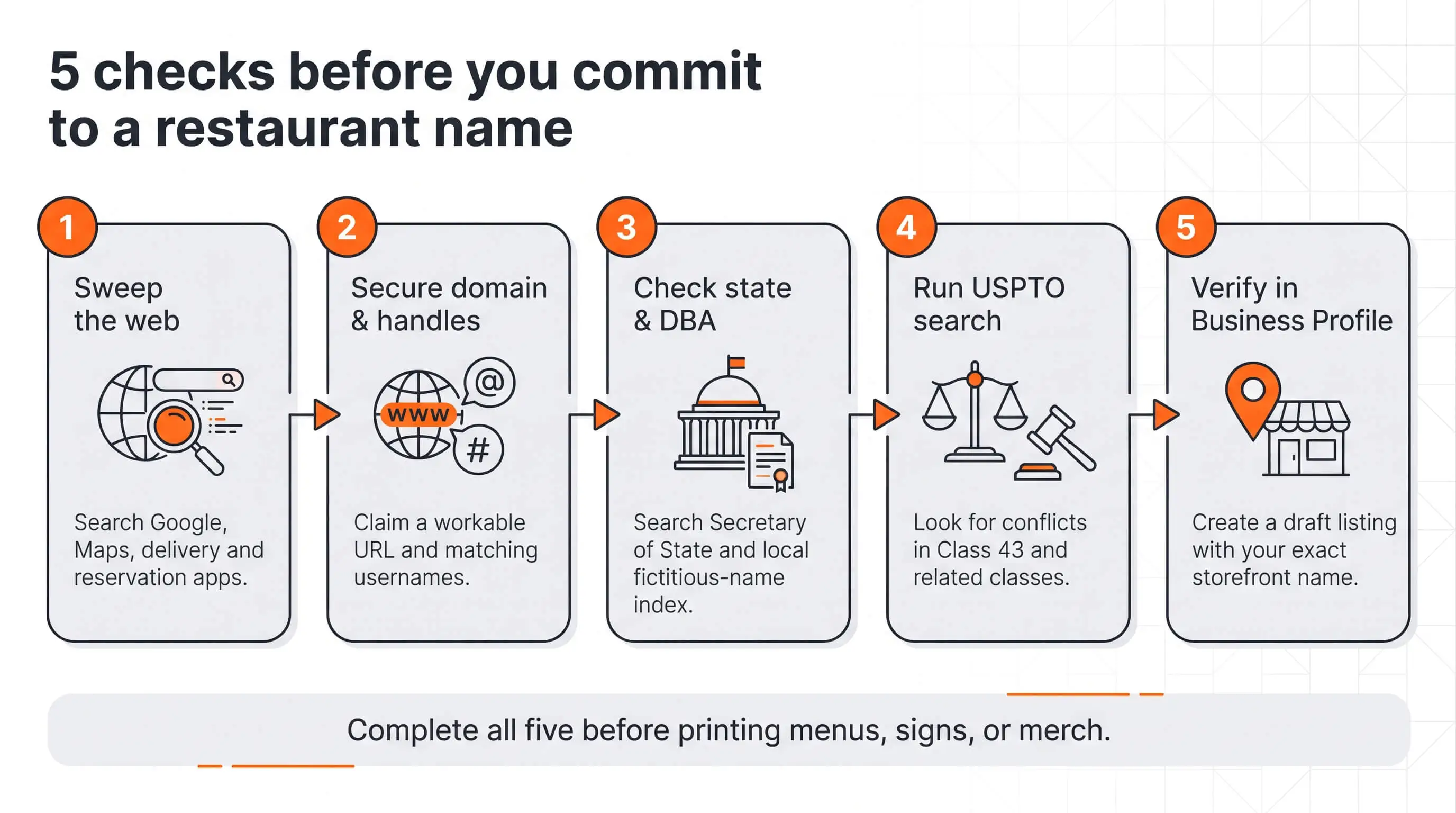
1. Sweep the web for close matches
Type the exact name plus your city into Google, Maps, delivery apps, and reservation platforms. Repeat with alternate spellings, plurals, and rhymes. You are looking for anything diners or search algorithms could confuse with you.
2. Secure a domain and social handles that work in real life
Follow three quick moves to claim digital real estate before someone else does:
Test the domain. At an accredited registrar, search the exact name. Treat the green available flag as a lead, not a guarantee. Ownership can change in minutes. If the dot-com is taken, add a short, intuitive modifier such as eat, kitchen, or your city code so guests can guess the URL on the first try.
Grab matching handles. Check Instagram, TikTok, Facebook, and any platform your diners love. Consistent usernames make you easier to find and remember across channels.
Confirm with RDAP. Since 28 January 2025, the Registration Data Access Protocol has replaced WHOIS for generic domains, and ICANN offers a free lookup to double-check ownership.
Lock the domain first, then claim the social handles within the same hour. That one-two punch keeps squatters from parking on your future brand and selling it back at a premium.
3. Check state business-name and DBA records
Search your Secretary of State database, then any county or city fictitious-name index. Acceptance only proves no one filed the identical letters in that jurisdiction; it does not create nationwide rights, according to the U.S. Small Business Administration.
4. Run a federal trademark search the right way
Do four quick searches inside the USPTO trademark-search tool:
Exact wording in Class 43 (restaurant services).
Look-alike spellings (Lantern / Lanturn).
Sound-alike names (Little Lantern / Lil Lantern).
Shared dominant words or meanings that could create the same “commercial impression.”
The USPTO notes that likelihood of confusion can arise from sight, sound, or meaning, not just identical words. Check both live and dead marks; cancelled filings may still carry consumer memory. Planning bottled sauce or merch? Search the coordinated food and clothing classes too.
Treat any result that feels even close as a yellow light and consult a trademark attorney before you spend on branding.
5. Verify the name in Google Business Profile
Start a draft profile with the exact wording you will mount on the sign. Google requires the online name to match real-world signage and forbids keyword stuffing. If a neighbor already uses the name, pick another because algorithms and guests will not spot the difference.
Check | Confirms | Doesn’t confirm |
Domain/handles | Control of URLs and usernames | Trademark rights |
State registry | Entity or DBA clearance in that state | Federal or common-law rights |
USPTO search | Potential national conflicts | Guaranteed approval |
Google Profile | Local identity and map clarity | Legal exclusivity |
5. Turning the name into a cohesive brand
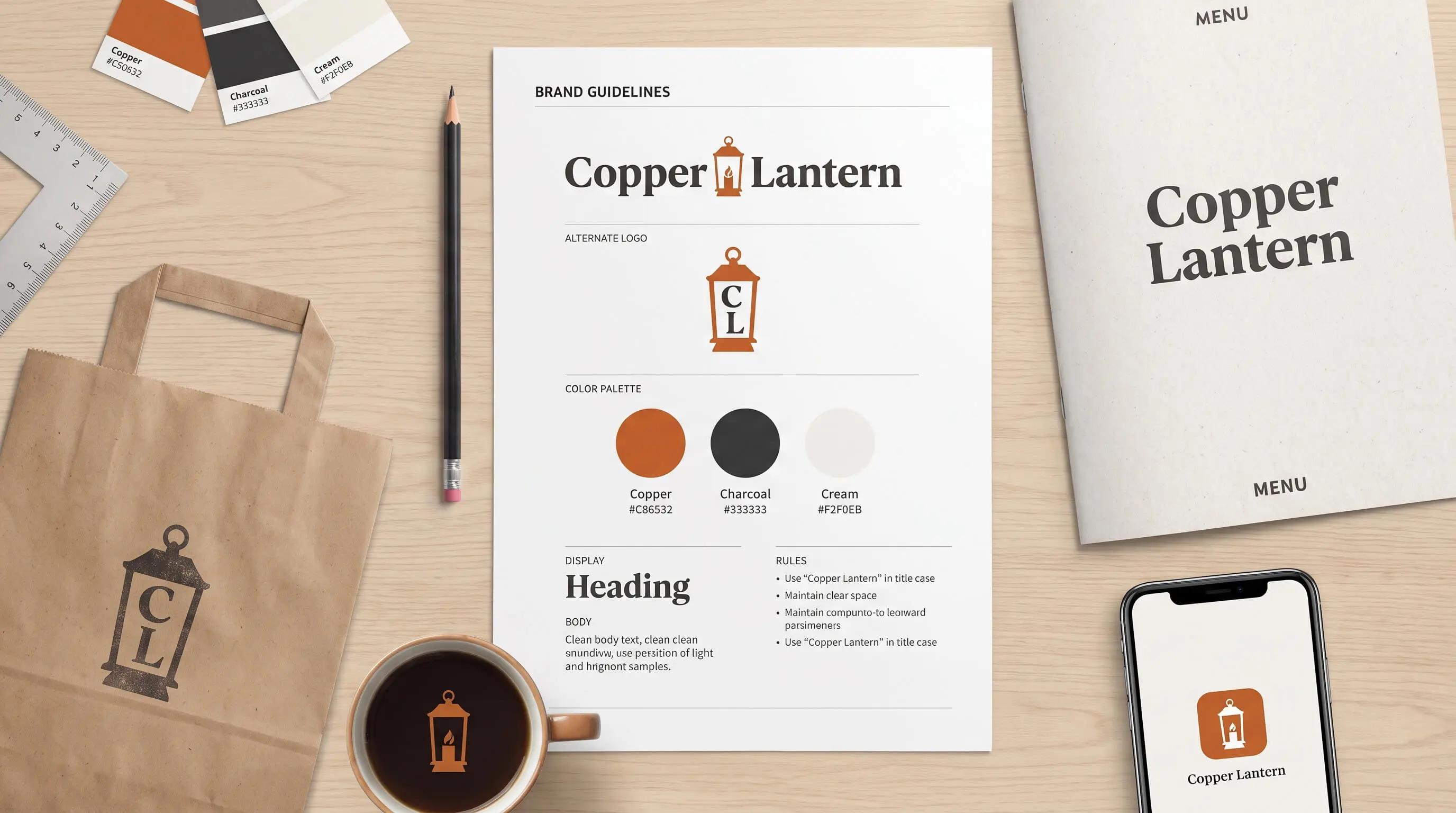
Write a one-sentence promise
Capture what guests should expect in one crisp line. For example, “smoky yakitori at neighborhood prices” or “a coastal wine bar with late-night snacks.” That promise guides every visual choice ahead.
Build a six-piece starter kit
Primary wordmark or logo
Stacked or horizontal alternate
Simple icon for avatars and delivery apps
Two- or three-color palette that works in print, neon, and one-color knock-out
Display typeface plus a readable body font
Clear rules for capitalization, spacing, and any descriptors
Stress-test the visuals in real settings
Tape the logo to the front window and step across the street at night. Shrink the icon to 32 px on your phone. Drop the mark onto receipts, coffee cups, delivery labels, and reservation emails. If it still reads fast and feels on brand, you are close.
Prototype with AI, finish with a designer
Generative-AI mock-ups can spark fresh color, texture, and sign ideas, but the U.S. Copyright Office says AI output is protectable only when a human supplies enough creative authorship. Recent design-research findings echo that AI excels at exploration while humans lock craft and originality. Use AI for mood boards, then hand the winning direction to a designer for original artwork, vector files, and production specs.
Lock these elements now so every contractor, from sign fabricator to menu printer, works from the same file set. Consistency protects the budget and gives guests one unmistakable mark to follow from sidewalk to smartphone.
6. Launching the new brand locally
A name proves its value only when real diners start repeating it. One option is to bring in a specialist who already works with independent operators. Fort Myers-based Quenzel Marketing Agency unites strategic marketing services, campaign management, and real-time metrics. Its restaurant marketing services for local restaurants turn research-driven plans into measurable covers and revenue you can see on the nightly report.
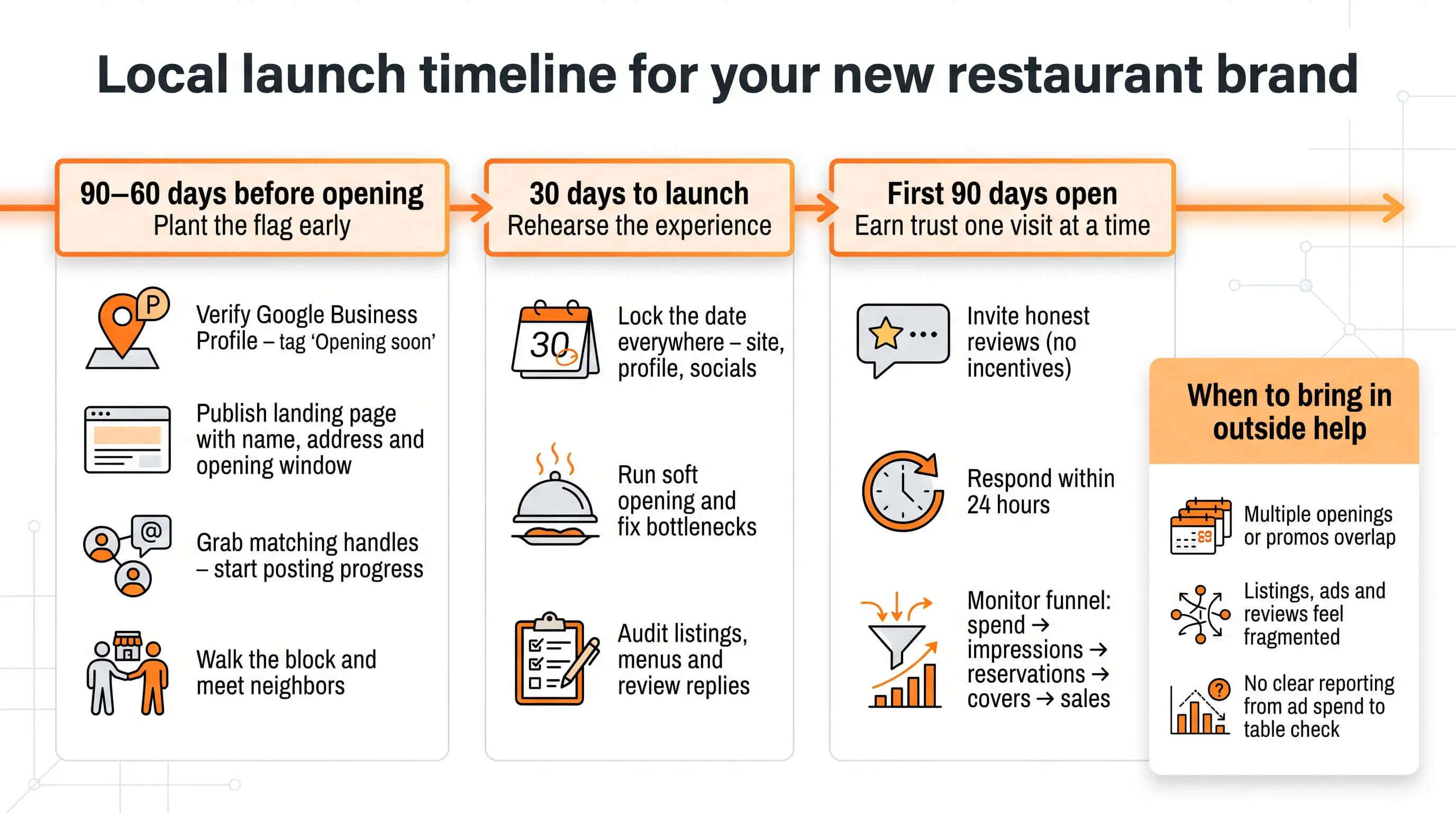
90-60 days before opening: plant the flag early
Work through four quick tasks that lock down your identity before construction dust settles:
Verify Google Business Profile. Claim the exact restaurant name and tag it Opening soon. Google can surface future openings up to 90 days in advance, complete with directions and a “Follow” button.
Publish a landing page. Mirror the name, address, and target opening window, then add an email box that promises first-week reservation access.
Grab matching handles. Secure Instagram, TikTok, and Facebook usernames the same day, then post construction shots, team intros, and ingredient teasers to build insider buzz.
Walk the block. Introduce yourself to neighboring businesses, HOA boards, and local groups so the ribbon-cutting crowd is already on your side.
Complete these steps and your brand will look established, both online and on the street, well before the first plate leaves the pass.
30 days to launch: rehearse the experience
Work through three critical drills before you open the doors:
Lock the date everywhere. Announce a firm opening only when kitchen, staff, and suppliers can deliver. Publish the date on your website header, Google Business Profile, and all social bios so guests never see conflicting info.
Run a soft opening. Invite friends and family for a tight menu and candid feedback. Stress-test order flow, booking links, and how easily servers share the name story. Adjust anything that stalls momentum, then update any printed or PDF menus and paid-ad copy.
Audit listings and coach review replies. Confirm that hours, menu details, photos, phone, and reservation buttons match across Google, Yelp, OpenTable, DoorDash, and your own site. Regulators forbid incentives tied to positive reviews, so thank happy guests, address issues, and never swap discounts for ratings.
Nail these details now, and your first public service will feel like week three, not day one.
The first 90 days: earn trust one visit at a time
Adopt three habits that turn early diners into steady advocates:
Invite, never buy, honest reviews. Thank each guest and explain that feedback helps neighbors discover new spots.
Respond within 24 hours. Celebrate the good, fix the bad, and log which dishes or service tweaks spark repeat visits. Watch for misspellings, duplicate listings, or third-party menus that still show last month’s prices, since consistency keeps algorithms and diners on your side.
Monitor the funnel weekly. Track spend → impressions → reservations → covers → sales. Early numbers show whether the name and story resonate or need sharper copy and visuals.
When to bring in outside help
Call in a marketing partner when three signs appear:
Multiple openings or promotions stack up faster than your team can manage.
Listings, ads, and reviews splinter across platforms with no single owner.
Reporting from ad spend to table check is missing or inconsistent.
7. Common naming mistakes to catch before you print the sign
Even the best process can trip over predictable traps. Review three groups of errors before you wire money to the sign maker.
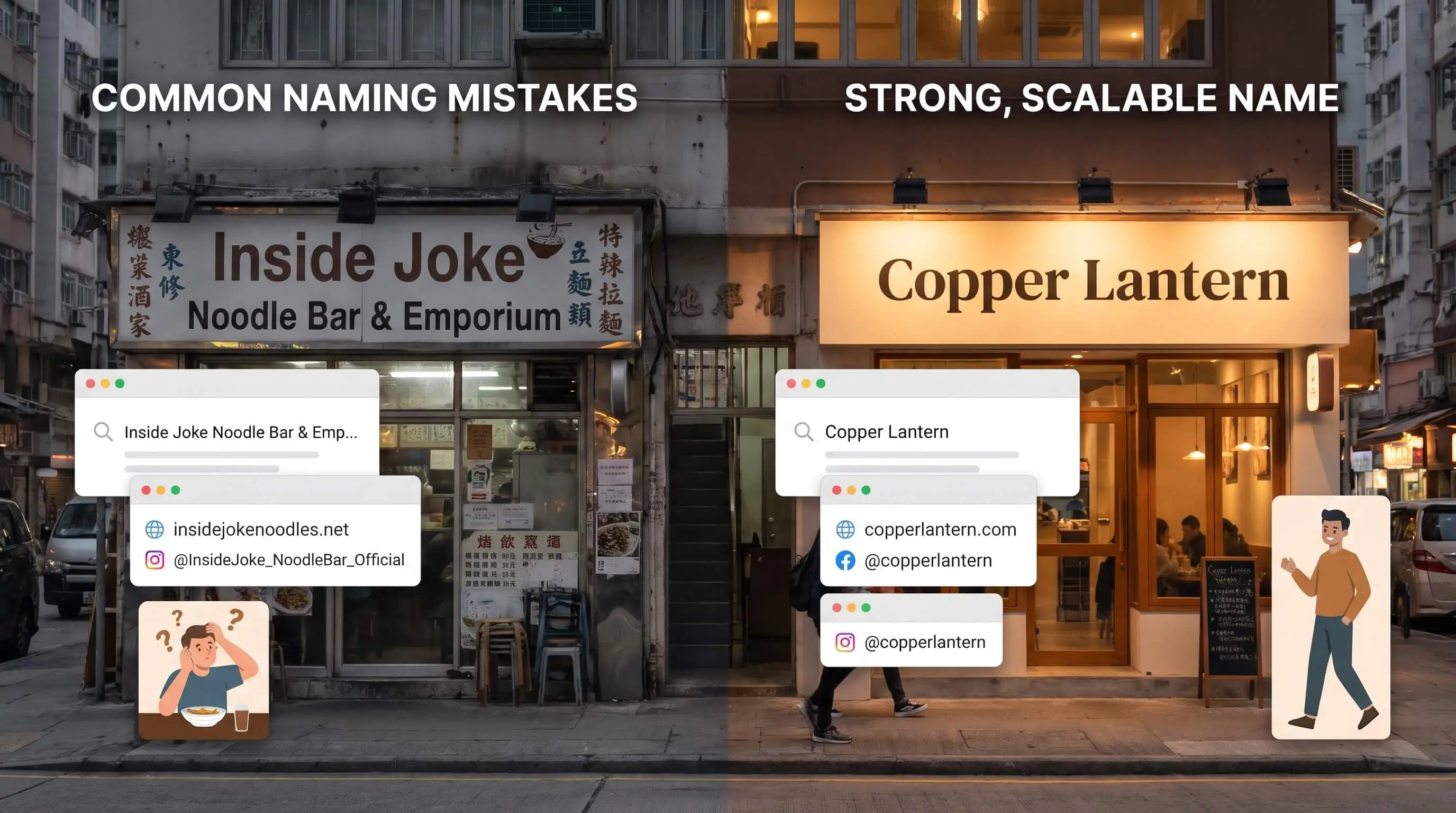
Creative slip-ups that turn off guests
Names longer than four words, private jokes that need explaining, or puns that wilt after the third hearing all push diners away. Foreign phrases copied from machine translation can read as nonsense or, worse, a slur. If a native speaker frowns, delete it.
Growth roadblocks hiding in plain sight
A brand tied to one dish, street, or micro-trend feels clever until the menu changes or you scout a second neighborhood. What looked edgy yesterday also ages fast once half a dozen competitors copy it. Leave room to stretch the menu, merch, and locations without bending the name.
Legal and digital traps that drain budget
An available dot-com is not trademark clearance, nor is a blank Instagram handle or a clean LLC filing. The USPTO warns that conflicts arise from similar sound, appearance, or meaning, not just identical spelling. Skip the similar-sound search or juggle punctuation across platforms and you invite costly confusion.
The last question to ask
Before you order signs, menus, or merch, pause and ask: “Will a stranger hear this name once, find us online in seconds and remember us tomorrow?” If the answer is yes (creatively, legally, and operationally) print the sign and unlock the doors.