

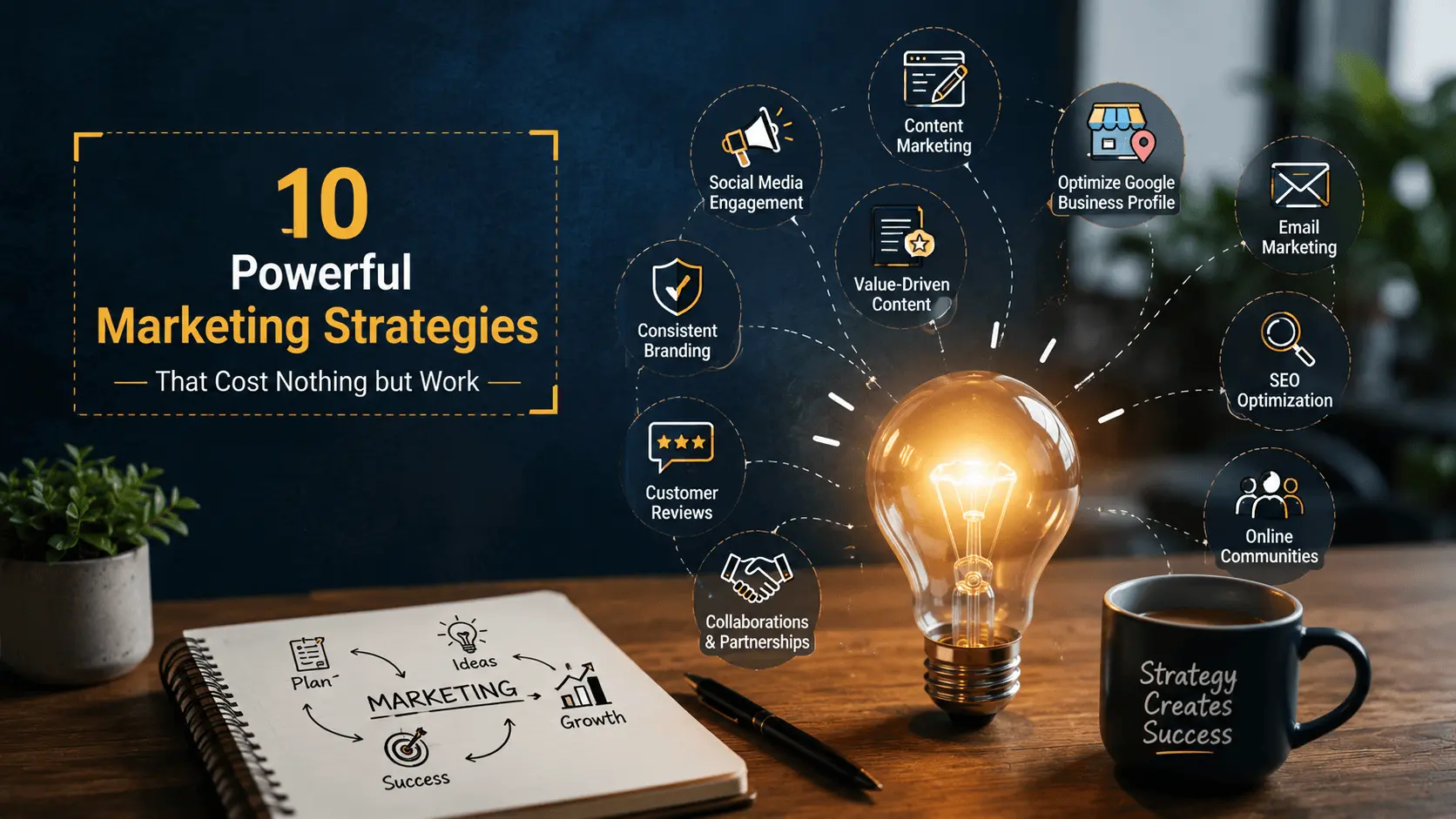
Every startup owner hits the same wall. You have a great product, a working website, and almost no budget for ads. Marketing feels like it belongs to companies with deep pockets, not to you. That belief stops more businesses from growing than any actual lack of money ever does.
The truth is simpler and more encouraging. Expensive advertising is not the only growth path. Many successful brands started with free marketing strategies that actually work, long before they could afford a single paid campaign. They built trust through content, showed up consistently, and let word of mouth do the rest.
This guide is built for founders who need results without a budget. You will learn how to market your business using time, skill, and consistency instead of cash. Every idea here counts as marketing without a budget, and every one of them is a proven small business marketing idea used by brands that grew from nothing.
Consistency matters more than spending. A single viral post rarely builds a business. Showing up week after week, refining your message, and listening to your audience is what turns free tactics into real business growth strategies. By the end of this guide, you will have ten strategies, a checklist, and the tools to start today.
Key Takeaways
You do not need a big budget to grow a business, only consistent effort.
Free marketing strategies build long-term trust, while paid ads buy short-term visibility.
Content, SEO, social media, and email form the backbone of organic growth.
Word of mouth and referrals remain the most trusted form of marketing today.
Tracking results helps you double down on what actually works for your audience.
Why Free Marketing Still Works
Shoppers are more skeptical of ads than ever before. They trust people, reviews, and real experiences over polished commercials. This shift is exactly why organic marketing strategies keep outperforming paid ones for small businesses building long-term brand equity.
Organic search still drives more website traffic than any other single channel, and that pattern is expected to continue through 2026. A well-written blog post can rank for years and bring in customers long after you hit publish. That kind of compounding return is nearly impossible to buy with ads alone.
Social sharing multiplies your reach for free. When a customer shares your product, tags your brand, or leaves a glowing review, their friends see it as a recommendation, not an advertisement. This is the same instinct behind word-of-mouth marketing, which most consumers still trust more than any paid message they see online.
Community engagement adds another layer of trust. Answering questions in forums, replying to comments, and showing up consistently online tells people a real business is behind the brand. Combined with free digital marketing strategies like SEO and email, these habits create a growth engine that never turns off, even while you sleep.
Paid Marketing vs Free Marketing: Which Should You Choose?
Startup owners often ask whether to spend on ads or invest time in free channels. The honest answer is that both play a role, but they solve different problems. Paid marketing buys speed. Free marketing builds a foundation that keeps paying you back.
Free Marketing | Paid Marketing |
Long-term results | Faster results |
Requires time | Requires money |
Builds authority | Builds visibility quickly |
Sustainable without ongoing spend | Budget-dependent |
High ROI over time | Immediate traffic |
If you need customers this week, a small paid campaign can help. But if you are building a business meant to last, free marketing strategies deserve most of your attention. The smartest founders use free tactics to build authority first, then add paid ads to amplify content that already works.
Think of free and paid marketing as partners, not competitors. A blog post that ranks organically can later become the basis for a paid ad. A loyal email list built for free can be retargeted with low-cost campaigns. Together, they create a marketing without a budget approach that still scales as revenue grows.
10 Powerful Marketing Strategies That Cost Nothing but Work
1. Create Helpful Content Your Audience Wants
Helpful content is one of the most reliable free marketing strategies available to any startup. Blog posts, tutorials, guides, FAQs, case studies, and short videos all answer real questions your customers are already asking. When you solve a problem before asking for a sale, trust builds naturally.
Start with the questions your customers ask most often. Turn each one into a blog post or short video. A tutorial on how to use your product removes friction for new buyers. A case study shows proof that your product actually works, which is far more convincing than any advertisement.
Educational content also compounds over time. Content marketing programs now generate a strong return for many businesses, and organic search remains one of the highest-ROI channels available, especially for brands that publish consistently instead of occasionally. A single well-researched guide can attract visitors for years without extra spending.
Keep every piece practical. Avoid vague advice and focus on steps readers can act on immediately. This is what separates real content marketing strategies from filler content nobody remembers. Helpful, specific, and honest content is still one of the most effective free marketing strategies that actually work.
2. Optimize Your Website for Search Engines (SEO)
SEO marketing tips are essential for any startup that wants free, ongoing traffic. Search engines reward websites that answer questions clearly and load quickly. Getting the basics right costs nothing except time, and the payoff can last for years.
Start with keyword research. Find the exact phrases your customers type into Google, then use them naturally in your titles, headings, and page content. On-page SEO, like clear headings and descriptive meta titles, helps search engines understand what each page is about.
Internal linking connects related pages on your site, helping visitors and search engines find more of your content. Image optimization, including compressed file sizes and descriptive alt text, improves both loading speed and accessibility. A fast, mobile-friendly design keeps visitors from bouncing away before they even see your offer.
Online marketing for small businesses almost always starts with SEO because it is free, sustainable, and scales with effort. Unlike ads, a well-optimized page keeps working even on days you do not post anything new. That passive traffic is one of the biggest advantages small businesses can build for free.
3. Build an Active Social Media Presence
Social media marketing tips only work when paired with consistency and a clear voice. You do not need to be everywhere at once. Pick one or two platforms where your audience already spends time, and show up there regularly.
LinkedIn works well for B2B founders sharing lessons and industry insights. Instagram and Pinterest suit visual products like fashion, food, or home goods. Facebook groups build community around shared interests, while X is useful for quick updates and public conversations with customers.
YouTube Shorts and other short-form videos currently deliver some of the strongest engagement of any content format. Behind-the-scenes clips, quick tutorials, and customer stories all perform well without needing a big production budget. A phone camera and good lighting are often enough to get started.
Engagement matters more than follower count. Reply to comments, ask questions in captions, and share customer content when they tag you. These small habits build genuine brand awareness tips into daily practice, turning followers into a community that talks about your business for free.
4. Build an Email List from Day One
Email marketing strategies remain one of the highest-return channels available to any business. Unlike social platforms, you own your email list. No algorithm change can take it away from you, which makes it a stable foundation for long-term customer acquisition strategies.
Start collecting emails before you even launch. A simple lead magnet, like a discount code, checklist, or free guide, gives visitors a reason to sign up. Even a small list of engaged subscribers can outperform a much larger, disengaged social following.
A strong welcome email sets the tone for the relationship. Introduce your story, explain what subscribers can expect, and deliver on your promised offer immediately. Regular newsletters keep your brand top of mind, sharing new products, helpful tips, and behind-the-scenes updates.
Email also drives customer retention better than almost any other channel. Repeat customers often generate more revenue than new ones, and a well-timed email can bring a past customer back with almost no cost. Building your list early is one of the smartest free business marketing tips available.
5. Encourage Word-of-Mouth and Customer Referrals
Most consumers say they trust word-of-mouth recommendations more than any other form of advertising. That trust makes referrals one of the most powerful and completely free marketing strategies a startup can use. Happy customers become your most convincing sales team.
Referral incentives give customers a reason to spread the word. A simple discount for both the referrer and the new customer often works better than a one-sided reward. Even a small incentive can turn quiet customers into active promoters of your brand.
Reviews and testimonials carry enormous weight with new shoppers. Ask satisfied customers to leave a review shortly after their purchase, while the experience is still fresh. User-generated content, like photos or unboxing videos, adds authentic proof that your product delivers on its promise.
Loyalty programs reward repeat behavior and keep customers engaged long after the first sale. Combined with referrals and reviews, they create a cycle where happy customers keep bringing in new ones. This is word-of-mouth marketing working exactly as intended, without spending a cent on ads.
6. Join Online Communities in Your Industry
Startup marketing tips often overlook one of the simplest tactics available: showing up where your customers already gather. Reddit threads, Facebook groups, LinkedIn communities, Quora questions, and niche forums are full of people actively looking for advice.
The key is providing real value before mentioning your business. Answer questions thoroughly, share genuine insights, and only bring up your product when it is truly relevant. Communities can spot self-promotion instantly, and it usually backfires.
Over time, consistent helpfulness builds recognition. People start to notice your username, trust your opinions, and eventually check out your profile or website on their own. This slow, organic approach reflects true organic marketing strategies, built on reputation instead of interruption.
Set aside a few minutes each day to engage in one or two communities. Small, consistent contributions add up far more than occasional bursts of activity. This patient approach is exactly why online communities remain such an effective, budget-free growth channel for startups.
7. Optimize Your Google Business Profile
Local business marketing ideas should always start with a fully optimized Google Business Profile. This free listing appears when nearby customers search for businesses like yours, making it one of the most valuable local SEO tools available.
Add clear, high-quality photos of your storefront, products, and team. Accurate business hours, a working phone number, and a complete address help customers find and trust you faster. An incomplete profile often gets skipped in favor of a competitor with fuller details.
Encourage customers to leave reviews after a purchase or visit, and respond to every review, positive or negative. Answering the Q&A section and posting regular updates shows Google and potential customers that your business is active and engaged.
For any business serving a local area, this single profile can drive a steady stream of nearby customers without spending on ads. It is one of the fastest, easiest wins among all the free marketing strategies available to small business owners today.
8. Collaborate with Other Businesses
Partnerships let two businesses share audiences without either one spending a dollar. Guest blogging on a partner's site introduces your brand to a completely new group of readers who already trust that publication.
Podcast interviews work the same way, putting your voice and expertise in front of an established audience. Cross-promotions, where two brands feature each other in emails or social posts, split the effort while doubling the exposure for both sides.
Webinars hosted jointly with a complementary business let you showcase expertise while sharing the workload of promotion. Joint giveaways attract entries from both audiences, growing your email list and social following at the same time.
The best collaborations feel natural, pairing brands that serve the same audience without competing directly. When done well, partnerships help both businesses grow faster than they could alone, using nothing more than shared trust and shared effort.
9. Repurpose Existing Content
One well-made piece of content can fuel weeks of marketing across multiple channels. A single blog post can become a LinkedIn post, an Instagram carousel, a short-form reel, a newsletter section, a YouTube video, an infographic, and even a podcast topic.
This approach maximizes the return on every hour spent creating content. Instead of starting from scratch for each platform, you are simply reshaping proven ideas into new formats. Readers on different platforms rarely see the same content twice, so repurposing rarely feels repetitive to your audience.
AI tools have made repurposing faster than ever. Many marketing teams now use AI to help draft variations, summarize long articles, and adapt tone for different platforms. Used carefully, alongside genuine human review, this keeps quality high while dramatically cutting production time.
Treat every piece of original content as raw material, not a finished product. This mindset shift alone can multiply your output without multiplying your workload, making it one of the most efficient content marketing strategies for resource-strapped startups.
10. Track Results and Improve Continuously
Free marketing only works if you know which parts are actually working. Google Analytics shows where your traffic comes from and what visitors do once they arrive. Search Console reveals which keywords bring people to your site, and where you are almost ranking on page one.
Social platforms provide their own insights, showing which posts get shared, saved, or ignored. Email metrics like open rates and click rates tell you what subject lines and offers resonate with your list. Conversion tracking connects all of this activity back to actual sales.
Reviewing this data monthly helps you spot patterns instead of guessing. Maybe your tutorials outperform your product posts, or your Tuesday emails get opened far more than your Friday ones. These small insights guide smarter decisions over time.
This is where business growth strategies become sustainable instead of accidental. Tracking results consistently is what separates marketing ideas that work from tactics that simply feel busy. Small, data-backed adjustments compound into major gains over a year of consistent effort.
Free Marketing Checklist for Small Businesses
Use this checklist to track your progress as you apply these marketing strategies for small business growth. Revisit it monthly and mark what is truly active, not just started once and forgotten.
Marketing Activity | Completed |
Website optimized for SEO | ✓ |
Blog published regularly | ✓ |
Social media active | ✓ |
Email list growing | ✓ |
Google Business Profile optimized | ✓ |
Customer reviews collected | ✓ |
Referral strategy implemented | ✓ |
Analytics monitored | ✓ |
Content repurposed | ✓ |
Community engagement maintained | ✓ |
Print this checklist or save it somewhere visible. These free business marketing tips only create results when applied consistently, not just read once and forgotten.
Common Free Marketing Mistakes to Avoid
Expecting instant results is the most common mistake startup owners make. Organic strategies like SEO and content marketing typically need several months before showing meaningful traffic. Giving up too early wastes all the effort already invested.
Posting inconsistently confuses both algorithms and audiences. A burst of five posts followed by weeks of silence performs worse than one steady post per week. Consistency signals reliability, both to search engines and to real customers.
Ignoring SEO means missing out on free, compounding traffic. Selling too aggressively, without offering value first, pushes potential customers away. Neglecting email marketing wastes one of the highest-return channels available to any business.
Ignoring customer feedback and skipping performance tracking round out the biggest mistakes. Every one of these errors is fixable. Avoiding them turns marketing without a budget from a frustrating guessing game into a reliable, cost-effective marketing idea that compounds over time.
Best Business Name Generator
Building a successful business starts with a strong and memorable brand identity, and that begins with choosing the right business name. A unique name helps customers recognize your brand, improves credibility, and creates a lasting first impression. Whether you're launching a startup or expanding into a new market, selecting the right name is a key step in your marketing strategy.
AI Bizname is a free AI-powered Business Name Generator that helps entrepreneurs, startups, and small business owners discover hundreds of creative, brandable, and industry-specific business name ideas in seconds. Simply enter your business niche, choose a naming style, and provide a few details to receive tailored suggestions that align with your brand vision and target audience.
Using AI Bizname saves time, sparks fresh ideas, and simplifies the branding process before you invest in logos, websites, or marketing campaigns. Whether you're starting your first business or rebranding an existing one, AI Bizname offers an easy, user-friendly way to find a professional business name that supports long-term growth and strengthens your overall marketing efforts.
Free Marketing Tools Every Business Owner Should Use
The right free tools make every strategy in this guide easier to execute. Each one below supports organic marketing and business growth without adding to your budget.
Google Analytics: tracks website visitors, traffic sources, and on-site behavior.
Google Search Console: shows how your site performs in search results and flags issues.
Google Trends: reveals what topics and keywords are rising in popularity.
Canva: creates social graphics, ads, and marketing materials without design skills.
ChatGPT: speeds up content drafts, brainstorming, and repurposing ideas.
Buffer: schedules and manages social media posts across platforms.
Mailchimp (Free Plan): builds and sends email newsletters to your list.
Meta Business Suite: manages Facebook and Instagram content and messages.
Grammarly: checks writing for clarity, tone, and grammar errors.
AnswerThePublic: surfaces real questions people search for around your topic.
Together, these tools cover research, creation, distribution, and tracking. Mastering even three or four of them can meaningfully upgrade the free digital marketing strategies you are already using.
Conclusion
Effective marketing does not always require a large budget. Consistent effort, valuable content, smart SEO, email marketing, and genuine community engagement can generate sustainable growth for any startup. The businesses that win are rarely the ones spending the most. They are the ones showing up the most consistently.
Focus on building trust, solving real customer problems, and measuring your results honestly. Every strategy in this guide works better together than alone, but you do not need to start with all ten at once.
Start with one or two strategies this week. Refine your approach as you learn what your audience responds to, then gradually expand as your business grows. Small, consistent action beats a perfect plan that never launches.
Pick one free marketing strategy from this guide and put it into action within the next seven days. Track the results, adjust what is not working, and keep building. That single step is how real business growth strategies begin.
Frequently Asked Questions
What are the best free marketing strategies for small businesses?
Content marketing, SEO, email marketing, social media, and referral programs are the most effective. They build trust and attract customers without any advertising spend.
Can I market my business without spending money?
Yes. Free marketing strategies like blogging, SEO, email, and community engagement can grow a business steadily using time and consistency instead of a budget.
How long does free marketing take to show results?
Most organic strategies need three to six months of consistent effort. SEO and content marketing often take longer but produce results that keep compounding over time.
Is SEO better than paid advertising?
SEO delivers slower but more sustainable results, while paid ads work faster but stop once spending stops. Combining both often produces the strongest overall outcome.
Which social media platform is best for business marketing?
It depends on your audience. LinkedIn suits B2B brands, Instagram and Pinterest suit visual products, and short-form video performs well across most industries today.
Does email marketing still work?
Yes, email remains one of the highest-return marketing channels available. It builds direct relationships with customers and drives repeat purchases at very low cost.
How can I get customers without running ads?
Focus on SEO, referrals, helpful content, and an active Google Business Profile. These channels attract customers who are already searching for solutions like yours.
What is the most effective organic marketing strategy?
Helpful, consistent content paired with SEO tends to deliver the strongest long-term results, since it keeps attracting new visitors long after publication.