

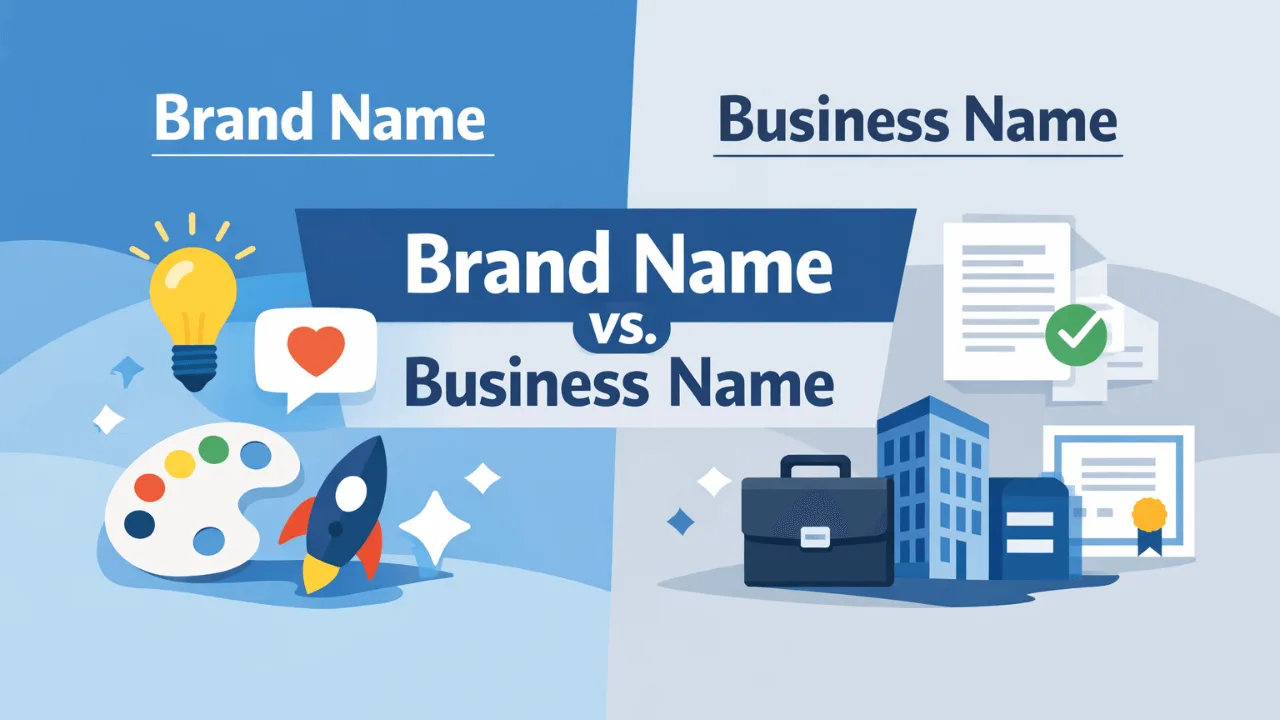
Did you know that a staggering 90% of businesses fail within the first decade? While many factors contribute to this, a clear understanding of your company's identity, including the distinction between your business name and your brand name, is fundamental to long-term survival and success. It’s a common point of confusion for entrepreneurs, but getting it right can profoundly impact how customers perceive and connect with your offerings.
Key Takeaways
A business name is the legal, official name of your company used for registrations, taxes, and contracts.
A brand name is the name consumers recognize and associate with your products or services, used for marketing and building customer relationships.
The business name is about legal identity and operations; the brand name is about market perception and emotional connection.
Your business name must be registered with government authorities, while your brand name is typically protected by a trademark.
Many businesses use the same name for both, but as companies grow, they may develop distinct brand names for different products or markets.
A strong brand name is crucial for differentiation, customer loyalty, and overall business success.
Choosing both names strategically is vital for legal compliance, marketing effectiveness, and long-term growth.
Think of it this way: your business name is your legal ID, while your brand name is your personality. They serve different, yet equally vital, purposes. Let’s dive deep into what each entails and why understanding their unique roles is crucial for any aspiring or established company.
What is a Business Name?
At its core, a business name is the official, legal name under which a company operates. It’s the name registered with government authorities for tax purposes, legal contracts, and other administrative functions. This name is often tied to the legal structure of your business, such as a sole proprietorship, partnership, LLC, or corporation.
Legal Identity and Registration
When you start a business, you'll need to register its name. This process varies by location, but generally involves:
Sole Proprietorships/Partnerships: You might operate under your own legal name. If you use a different name (a "fictitious name" or "doing business as" or DBA), you'll typically need to register this DBA with your local or state government. For example, if John Smith runs a landscaping business as 'GreenThumb Landscaping,' 'GreenThumb Landscaping' is his DBA, and he might need to register it.
Limited Liability Companies (LLCs) and Corporations: These entities have a distinct legal identity separate from their owners. The business name is the one officially filed with the Secretary of State (or equivalent) when forming the LLC or corporation. This name becomes the legal entity that can enter into contracts, own assets, and be sued.

The Purpose of a Business Name
The primary functions of a business name are:
Legal Compliance: It ensures your business is recognized by the law.
Financial Transactions: It’s used for opening bank accounts, filing taxes, and processing payments.
Contracts and Agreements: It’s the name that appears on all official documents.
Credibility and Professionalism: A registered business name lends an air of legitimacy to your operations.
Examples of Business Names:
Apple Inc. (The legal entity)
Microsoft Corporation (The legal entity)
Google LLC (The legal entity)
It's important to note that the business name might not be the name you most commonly associate with the company's products or services.
What is a Brand Name?
A brand name is the name that consumers recognize and associate with a company's products, services, or the overall company itself. It’s the name that evokes emotions, builds recognition, and creates a unique identity in the marketplace. While it can sometimes be the same as the business name, it often serves a more strategic marketing purpose.
Marketing and Consumer Perception
The brand name is about building a connection with your audience. It’s carefully crafted to be memorable, appealing, and reflective of the company's values, mission, and the benefits it offers. A strong brand name can:
Differentiate yourself from competitors.
Communicate your unique selling proposition.
Build trust and loyalty among customers.
Command premium pricing.
Facilitate product line extensions.
The Power of Branding
Branding goes far beyond just a name. It encompasses your logo, tagline, visual identity, customer service, and the overall experience customers have with your company. The brand name is the anchor for all these elements. As renowned marketing expert Marty Neumeier stated in his book, The Brand Gap, "Branding is the art and science of telling your story to the right audience at the right time in the right way." The brand name is often the first chapter of that story.

Examples of Brand Names:
Apple (The brand consumers know, often distinct from its legal entity name)
Windows (A product brand of Microsoft Corporation)
Gmail (A product brand under Google LLC)
Nike (The brand associated with athletic wear, distinct from its legal name, Nike, Inc.)
In many cases, the brand name is more widely recognized than the legal business name. For instance, most people know and use "Google" for search, even if they're technically interacting with services provided by "Google LLC."
Key Differences Summarized
To crystallize the distinction, let's look at the core differences:
Feature | Business Name | Brand Name |
Primary Role | Legal and administrative identity | Marketing, recognition, and customer connection |
Purpose | Compliance, contracts, and financial transactions | Differentiation, loyalty, emotional connection |
Registration | Government agencies (state, local, federal) | Trademark protection (USPTO in the US), market usage |
Focus | Legal structure and operations | Customer perception and market positioning |
Flexibility | Generally, more rigid once registered | Can evolve with market trends and company strategy |
Origin | Legal requirements, founder's choice | Strategic marketing, consumer appeal, and memorability |
Business Name as Brand Name (and Vice Versa)
It's perfectly common for a business name and a brand name to be identical. Many small businesses, especially those starting, use their founder's name or a descriptive name that serves both legal and branding purposes. For example, if Sarah opens a bakery called 'Sarah's Sweet Treats LLC,' then 'Sarah's Sweet Treats' functions as both her business name and her brand name.
However, as businesses grow, they might create separate brand names for different product lines or services to target specific markets. Conversely, a very strong brand name might eventually lead a company to change its legal business name to better align with its public identity. This happened with Google, which rebranded its parent company to Alphabet Inc. in 2015, while retaining "Google" as its primary brand name for its search engine and other core products. This move was largely strategic, allowing for better organization of its diverse ventures under a single corporate umbrella while preserving the powerful Google brand.
Why Does the Distinction Matter?
Understanding the difference between a brand name and a business name is crucial for several reasons:
1. Strategic Marketing and Positioning
Your brand name is your primary tool for marketing. It’s what you’ll use in advertising, on your website, and in social media. A well-chosen brand name can resonate with your target audience, communicate your core message, and set you apart from competitors. If your business name is cumbersome or uninspired, but your brand name is catchy and relevant, you can still build a powerful market presence. For instance, the legal entity 3M is a diversified technology company, but its brand names, like Post-it Notes and Scotch Tape, are what consumers recognize and trust.
2. Legal Protection and Intellectual Property
While your business name is registered legally, your brand name is what you typically protect with a trademark. A trademark gives you exclusive rights to use that name in connection with your goods or services. This is vital for preventing competitors from using a similar name to confuse your customers. The United States Patent and Trademark Office (USPTO) is the governing body for trademarks in the US.
According to the USPTO, a trademark is a word, phrase, symbol, and/or design that identifies and distinguishes the source of the goods of one party from those of others. This protection is paramount for building brand equity and preventing dilution.
3. Business Growth and Expansion
As your business grows, you might introduce new products or services. Having distinct brand names for these can help you target different customer segments effectively. For example, a company that manufactures high-end audio equipment might create a separate brand for more affordable, entry-level speakers. This allows each brand to have its own identity and marketing strategy without confusing customers or diluting the premium image of the original brand.
4. Investor Relations and Mergers
Investors often look at brand recognition and market share when evaluating a company. A strong, well-established brand name can be a significant asset. In cases of mergers or acquisitions, the brand value of the acquired company is a key consideration. The acquiring company might retain the acquired brand name if it has strong market recognition, even if the legal entity name changes.
5. Online Presence and Domain Names
In today's digital world, your brand name is often the first thing people encounter online. Securing a relevant domain name (e.g., yourbrandname.com) is critical. If your business name is not brandable or is already taken as a domain name, you might need to choose a different, more marketable brand name for your online presence. This is where services like AI Biz Name can be incredibly helpful in generating memorable and available brand names.
Choosing the Right Names
When you’re starting, you might be juggling both. Here are some tips for choosing effective names:
For Your Business Name:
Check Availability: Ensure the name isn’t already registered as a business name in your jurisdiction.
Keep it Simple: It should be easy to spell and pronounce.
Reflect Your Structure: If you're an LLC, your business name will likely need to include "LLC."
For Your Brand Name:
Memorability: Is it easy to remember and recall?
Relevance: Does it hint at what you do or the value you provide?
Uniqueness: Does it stand out from competitors?
Scalability: Will it still work if you expand your offerings?
Positive Connotation: Does it evoke positive feelings or associations?
Availability: Is the domain name available? Are social media handles free? Is it trademarkable?
AI-powered tools can be invaluable in this process. They can analyze vast amounts of data to suggest names that are not only creative but also available for registration and domain purchase. AI Biz Name offers sophisticated algorithms to help entrepreneurs discover the perfect name that balances creativity with practical considerations.

Case Studies: Brands That Got It Right
1. Amazon
Business Name: Amazon.com, Inc.
Brand Name: Amazon
Jeff Bezos famously started Amazon as an online bookstore. The business name, Amazon.com, Inc., is its legal identifier. However, the brand name "Amazon" evokes vastness (like the Amazon River), growth, and a wide selection of products. The brand has evolved far beyond books, and the name has proven incredibly adaptable, covering everything from cloud computing (AWS) to streaming services.
2. Coca-Cola
Business Name: The Coca-Cola Company
Brand Name: Coca-Cola (and Coke)
The Coca-Cola Company is the legal entity. The brand name "Coca-Cola" and its shortened version "Coke" are globally recognized symbols of refreshment and a particular taste. The brand is so powerful that it often overshadows the legal company name in everyday conversation.
3. Tesla
Business Name: Tesla, Inc.
Brand Name: Tesla
Tesla, Inc. is the legal business name. The brand name "Tesla" is synonymous with electric vehicles, innovation, and Elon Musk’s ambitious vision. It’s a name that inspires excitement and represents cutting-edge technology, making it highly effective for marketing and customer engagement.
Common Pitfalls to Avoid
Confusing the two: Thinking your registered business name is automatically your brand name, or vice versa.
Choosing a business name that's hard to brand: A legal name that's too generic or difficult to pronounce can hinder marketing efforts.
Failing to trademark your brand name: This leaves your brand vulnerable to imitation.
Ignoring domain name and social media availability: A great brand name is less effective if you can't secure its online identity.
Conclusion
In the complex world of business, clarity is king. The distinction between your business name and your brand name is fundamental to building a successful and sustainable enterprise. Your business name provides the legal foundation, ensuring you operate within the bounds of the law and conduct transactions smoothly. Your brand name, on the other hand, is the heart and soul of your market presence. It’s how you connect with customers, build loyalty, and carve out your unique space in the world.
While they can sometimes overlap, recognizing their distinct roles enables more strategic decision-making in marketing, legal protection, and long-term growth. By carefully considering and developing both your business name and your brand name, you lay the groundwork for a company that is not only legally sound but also resonates powerfully with the people you aim to serve.
Frequently Asked Questions (FAQs)
Q1: Can my business name and brand name be the same?
Absolutely! Many small businesses operate successfully with a single name that serves both as their legal business name and their brand name. For example, a local bakery named 'Sweet Delights Bakery LLC' uses 'Sweet Delights Bakery' for both its legal registration and its customer-facing brand.
Q2: When should I consider having a different brand name from my business name?
You might consider a different brand name if:
Your business name is too generic or difficult to market.
You are launching a new product line that targets a completely different audience or market segment.
You want to distance a new venture from your existing business for strategic reasons.
Your business name is already taken as a domain name or social media handle.
Q3: How do I protect my brand name?
In the United States, you protect your brand name through a trademark with the U.S. Patent and Trademark Office (USPTO). This grants you exclusive rights to use the name for specific goods or services, preventing others from using a confusingly similar mark. Registration is a crucial step for building brand equity and preventing infringement.
Q4: What happens if someone else uses my brand name?
If someone else uses your trademarked brand name without permission for similar goods or services, it constitutes trademark infringement. You can take legal action to stop them, which may involve sending a cease-and-desist letter or filing a lawsuit. The strength of your trademark registration will be key in such a dispute.
Q5: Is it better to have a descriptive brand name or an abstract one?
There's no single "better" approach; it depends on your strategy. Descriptive brand names (e.g., "General Electric") clearly communicate what the company does, which can be helpful for clarity. Abstract or coined names (e.g., "Kodak," "Xerox") are often more unique, memorable, and easier to trademark; however, they require more marketing effort to associate them with specific products or services.
Q6: How can AI tools help me choose a brand name?
AI tools, like those offered by AI Biz Name, can analyze market trends, check for name availability (including domain names and social media handles), suggest creative name ideas based on your industry and keywords, and even assess potential trademark conflicts. They can significantly speed up the brainstorming process and help you discover unique, viable options.
External Resources
U.S. Small Business Administration (SBA): Offers guidance on naming your business, including legal considerations and registration processes. https://www.sba.gov/
United States Patent and Trademark Office (USPTO): Provides comprehensive information on trademarks, how to search for existing marks, and the application process. https://www.uspto.gov/
Investopedia: Offers articles and definitions related to business structures, branding, and intellectual property. https://www.investopedia.com/