

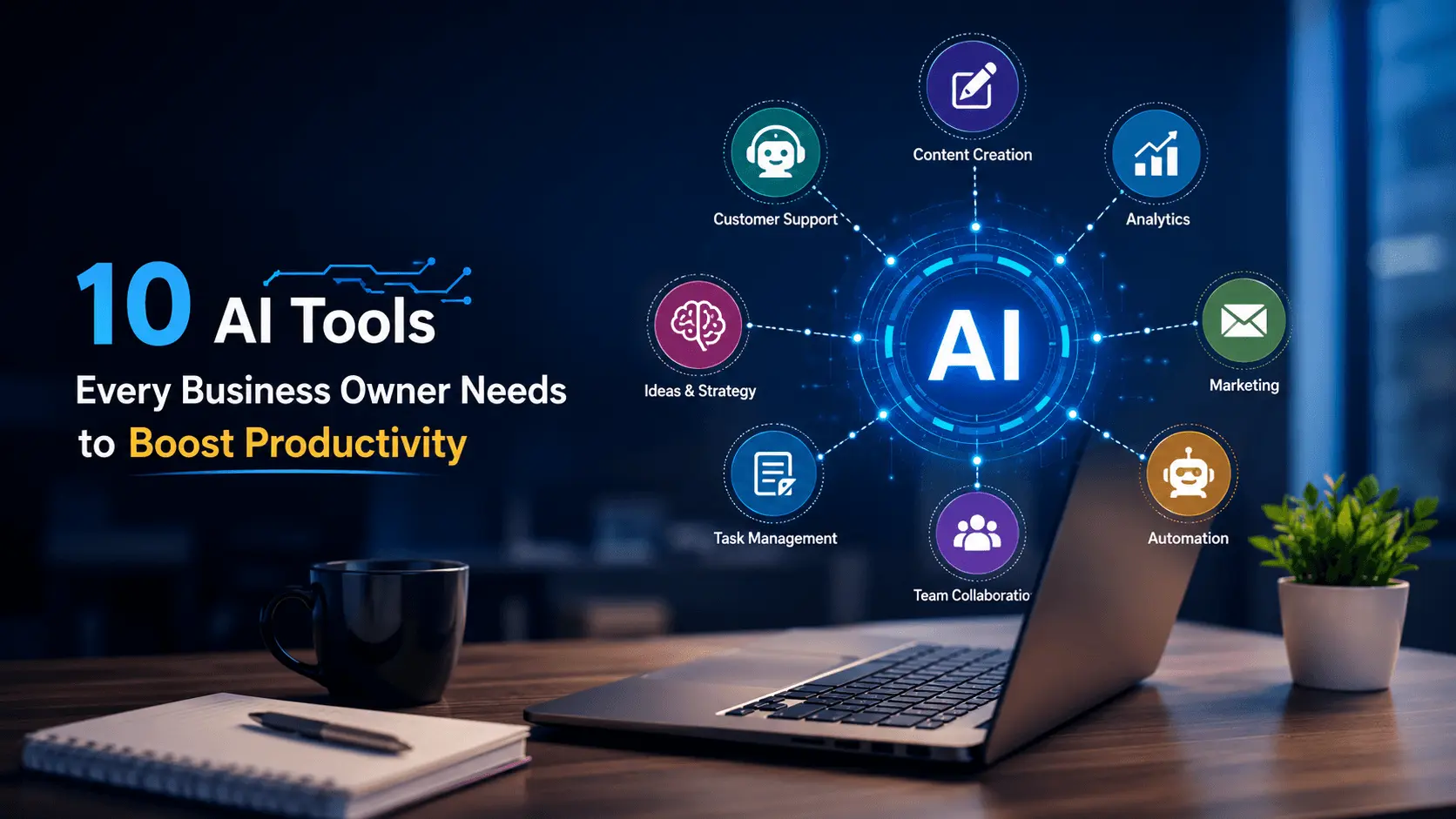
Running a small business today means wearing ten different hats before lunch. You are the marketer, the customer support agent, the content writer, the bookkeeper, and the strategist, often all in the same afternoon. AI is transforming businesses of every size, and it is doing so faster than any technology cycle before it. Small businesses and startups now have access to enterprise-level tools that once required a full technical team and a six-figure budget. Today, a two-person online store can run marketing, support, and reporting with the same efficiency as a company twenty times its size.
This shift matters because most business owners struggle with the same core problems: marketing that takes too long, customer support that never stops, content creation that drains creative energy, branding that feels impossible to nail down, and workflow management that gets messier as the business grows. AI helps save time, reduce costs, improve customer service, automate repetitive work, and boost revenue, often all at once. According to the U.S. Chamber of Commerce, 89% of small businesses are now using AI in some form, up from just 36% in 2023. That is not a trend anymore. It is the new baseline for staying competitive.
This guide covers the best AI tools for business owners who want practical, proven solutions instead of hype. These are AI productivity tools that founders, freelancers, and store owners are actually using every day to save hours, cut costs, and grow faster. Whether you need AI apps for business writing, design, automation, or customer relationship management, the AI business tools below are built to solve real problems, not add more complexity to your day.
Key Takeaways
AI adoption among small businesses has grown dramatically, with the majority now using AI in some form.
The right AI tools save hours every week and directly support revenue growth, not just convenience.
ChatGPT, Claude, and Jasper AI cover most writing and marketing needs for business owners.
Canva AI and Notion AI handle design and documentation without requiring specialist skills.
Zapier AI and Fireflies AI automate the repetitive, time-consuming parts of running a business.
Choosing the right business name with a tool like AI Bizname is a smart first step before launch.
Start small, measure results, and expand your AI toolkit gradually rather than all at once.
Why Every Business Needs AI
AI is no longer optional for business owners who want to stay competitive. Growing competition means the businesses using AI well are pulling ahead of those still doing everything manually. Automation saves hundreds of hours a year on tasks like scheduling, replying to leads, and organizing documents. Business .com reports that small businesses save an average of 5.6 hours per week using AI tools, while owners and managers personally save more than 7 hours a week.
AI also improves the customer experience by responding faster and more consistently than a stretched-thin support team ever could. It supports faster decision-making by summarizing data, meetings, and reports in seconds instead of hours. Salesforce research found that 91% of small businesses using AI report revenue increases, a clear sign that these tools directly affect the bottom line, not just convenience.
Reduced operational costs are another major driver. Many business owners are cutting marketing contractor costs by 50 to 70% after bringing AI into their content workflows, since tools like Claude and ChatGPT together cost around $40 a month compared to thousands for outsourced help. Increased team productivity rounds out the picture: the U.S. Chamber of Commerce found small business AI usage jumped from 40% to 58% in a single year, and adoption keeps climbing as more owners see measurable results. In 2026, ignoring AI is no longer a neutral choice. It is a competitive disadvantage.
Quick Comparison Table
Tool | Best For | Free Plan | Starting Price |
ChatGPT | Writing & Research | Yes | $$ |
Canva AI | Design | Yes | $$ |
Notion AI | Documentation | Yes | $$ |
Grammarly | Writing | Yes | $$ |
Zapier AI | Automation | Limited | $$ |
Claude | Long-form Writing | Yes | $$ |
Jasper AI | Marketing | Trial | $$$ |
HubSpot AI | CRM | Yes | $$ |
Fireflies AI | Meetings | Yes | $$ |
AI Bizname | Business Naming | Free | Free |
10 AI Tools Every Business Owner
1. ChatGPT
ChatGPT is one of the most widely used AI apps for business owners who need a flexible assistant for writing, planning, and problem-solving. It works like a knowledgeable team member who never runs out of patience or ideas.
Key Features: Content writing, brainstorming, coding help, customer support scripts, market research, business planning, and email writing.
Best For: Entrepreneurs, startups, agencies, and ecommerce sellers who need one tool that handles many different tasks.
Pros: Extremely versatile, fast responses, strong at generating first drafts and ideas quickly.
Cons: Requires clear prompts to get accurate results, and outputs still need a human review pass.
Pricing: Free plan available, with paid plans priced in the mid-range for expanded features and higher usage limits.
Why Business Owners Love It: It replaces hours of blank-page staring with a working draft in seconds, whether that is a product description, an email, or a business plan outline.
2. Canva AI
Canva AI turns basic design tasks into a five-minute job instead of a five-hour one. It is one of the best AI tools for business owners without a background in graphic design.
AI Features: Magic Design for instant layouts, AI image generation, presentation building, social media post creation, short video creation, and brand kit tools that keep colors and fonts consistent.
Best Use Cases: Social media graphics, product mockups, pitch decks, and branded marketing materials for ecommerce stores.
Pricing: The free plan covers most small business needs, with paid tiers unlocking premium templates and advanced AI features.
Pros & Cons: Pros include an easy drag-and-drop interface and strong brand consistency tools. The main con is that highly custom or complex designs may still need a professional designer.
3. Notion AI
Notion AI is built for business owners who need to keep documentation, plans, and projects organized in one place instead of scattered across apps.
Features: AI-assisted notes, SOP creation, project planning boards, a searchable knowledge base, instant AI summaries of long documents, and task management.
Best For Teams: Remote and hybrid teams that need a single source of truth for processes, meeting notes, and ongoing projects.
Pricing: Free plan for individuals and small teams, with paid plans scaling based on team size and storage needs.
Notion AI shines for founders who keep saying "I need to document this process" but never find the time. It turns messy notes into clean, structured SOPs in minutes.
4. Grammarly
Grammarly is one of the simplest AI productivity tools to adopt because it works quietly in the background of tools you already use, like email and Google Docs.
Features: Grammar and spelling correction, tone detection, AI-powered rewriting suggestions, and templates for business emails and reports.
Why It Saves Time: Instead of re-reading every email three times before sending, Grammarly catches errors and tone issues instantly, which matters when you are writing to clients, vendors, or investors.
Pricing: The free plan covers basic grammar checks, while paid plans add advanced tone and clarity suggestions for business writing.
5. Zapier AI
Zapier AI connects the other tools in your stack so information moves automatically instead of being copied and pasted by hand.
Features: Workflow automation between apps, CRM automation, email automation, AI agents that handle multi-step tasks, and thousands of integrations with popular business software.
Business Examples: Automatically reply to new leads within minutes, save form submissions directly into a spreadsheet or CRM, send invoices without manual entry, and notify your team the moment a new order comes in.
Pricing: Limited free plan for light automation needs, with paid tiers unlocking more tasks and premium integrations.
Zapier AI is often the tool that turns a collection of separate apps into one connected system, which is exactly what a growing ecommerce business needs.
6. Claude AI
Claude stands out among AI apps for business owners who need longer, more nuanced writing, like detailed reports, policies, or research summaries.
Why It's Great: It handles long documents without losing context, which makes it useful for anything more complex than a short social caption.
Features: Long-form writing, document analysis, coding support, and structured brainstorming for business strategy.
Best For: Agencies producing client reports, researchers summarizing data, and business owners drafting detailed internal reports or policies.
Claude is frequently paired with ChatGPT in small business stacks, since the combined monthly cost of both tools is still far cheaper than a single freelance writer or analyst.
7. Jasper AI
Jasper AI is built specifically around marketing output, which makes it one of the best AI tools for business owners who run their own campaigns.
Features: Marketing copy generation, product descriptions at scale, blog writing, ad copy variations, and SEO-focused content suggestions.
Best For: Marketing teams and solo founders who need to produce a high volume of on-brand content across channels.
Pricing: Trial available, with paid plans priced higher than general-purpose tools since it is built for marketing-specific output.
For ecommerce sellers with hundreds of product listings, Jasper AI can turn a task that used to take days into an afternoon.
8. HubSpot AI
HubSpot AI brings artificial intelligence directly into your customer relationship management, so your sales and marketing data actually talk to each other.
AI Features: CRM automation, AI-assisted email writing, sales pipeline suggestions, marketing campaign support, lead management scoring, and automatically generated AI reports.
Why Businesses Use It: It keeps every customer interaction in one system, so nothing falls through the cracks as your customer list grows.
Pricing: A free plan is available for core CRM features, with paid tiers adding deeper AI and automation capabilities.
9. Fireflies AI
Fireflies AI is one of the most practical AI productivity tools for business owners who spend a large chunk of their week in meetings.
Features: Automatic meeting recording, AI-generated summaries, action item extraction, and searchable transcripts across past conversations.
Best For: Remote teams that need a reliable record of decisions made in calls, without someone manually taking notes the whole time.
Pricing: Free plan for basic recording and transcription, with paid plans adding deeper search and integration features.
Instead of scrambling to remember what was agreed on last Tuesday's call, Fireflies AI gives you a searchable record with the action items already pulled out.
10. AI Bizname – Best Business Name Generator
Why Choosing the Right Business Name Matters
Before launching a business, one of the most important decisions you will make is choosing a memorable and brandable business name. A strong name creates a lasting first impression, builds trust with customers, improves brand recognition, and makes marketing much easier. Unfortunately, many entrepreneurs spend days, or even weeks, trying to come up with the perfect name.
That is where AI Bizname comes in. Instead of manually brainstorming hundreds of ideas, AI Bizname uses artificial intelligence to generate unique, creative, and industry-specific business names in seconds. Whether you are starting an ecommerce store, SaaS company, restaurant, agency, clothing brand, or local business, the tool delivers personalized name suggestions based on your niche and preferences. It helps eliminate creative blocks while saving valuable time during the early stages of your business journey.
Business Name Generator: Starting a business begins with choosing a name that is memorable, unique, and aligned with your brand identity. AI Bizname is a free AI-powered business name generator designed to help entrepreneurs, startups, freelancers, and business owners discover creative business names within seconds. Instead of spending hours brainstorming ideas, users simply enter their industry or keywords, and the tool instantly generates hundreds of professional, brandable name suggestions. This makes it one of the most useful AI-powered business tools for anyone launching a new venture or rebranding an existing business.
What makes AI Bizname especially valuable is its speed, simplicity, and versatility. Whether you are creating an ecommerce store, tech startup, marketing agency, fashion brand, restaurant, or local business, the platform provides relevant naming ideas tailored to your niche. A strong business name improves brand recognition, marketing effectiveness, and customer trust, making AI Bizname a practical first step before building your website, logo, or marketing strategy. If you are looking for a reliable business name generator, AI Bizname is an excellent tool to kickstart your entrepreneurial journey.
How to Choose the Right AI Tool for Your Business
With so many AI apps for business available, picking the right one can feel overwhelming. Start with your budget, since some tools are free while others scale in price as your usage grows. Consider your team size, too, because a solo founder has very different needs than a team of fifteen.
Your industry matters as well. An ecommerce store needs different AI productivity tools than a consulting firm or a local service business. Ease of use is just as important as features, since a powerful tool nobody on your team wants to open provides zero value. Think about your automation needs honestly. Not every business needs complex workflow automation right away, and it is fine to start simple.
Check integrations before you commit, since a tool that does not connect with your existing software creates more manual work, not less. Scalability matters if you expect to grow quickly, so look for tools with room to expand rather than ones you will outgrow in six months. Customer support quality can make or break your experience when something breaks at the worst possible time.
Data privacy deserves real attention, especially if the tool touches customer information, payment details, or internal business documents. Finally, always come back to ROI. The best AI business tools are the ones that clearly save time, reduce costs, or increase revenue in a way you can actually measure. If a tool cannot show its value within the first month, it is worth reconsidering.
Common Mistakes to Avoid When Using AI
Depending completely on AI is one of the most common mistakes business owners make. These tools are assistants, not replacements for judgment, especially in areas like legal, financial, or customer-sensitive communication. Ignoring human review is closely related. AI-generated content and decisions should always get a final check from a real person before they go out to customers.
Using too many AI tools at once creates confusion instead of productivity. It is better to master two or three tools deeply than to juggle ten you barely understand. Poor prompts lead to poor results, and many business owners give up on a tool simply because they never learned how to ask it clearly for what they need.
Not protecting sensitive business data is a serious risk. Avoid pasting confidential customer data, financial records, or trade secrets into tools without understanding their privacy policies. No workflow planning is another common trap. Adding AI to a messy process just makes the mess move faster, so it helps to map out your workflow before automating it.
Finally, choosing tools without ROI in mind wastes both time and money. Every AI tool added to your stack should have a clear job to do and a way to measure whether it is doing that job well.
Final Thoughts
AI is becoming essential for modern businesses, not because it is trendy, but because it solves real, everyday problems around time, cost, and growth. The businesses seeing the biggest gains are not the ones using the most tools. They are the ones who matched the right AI productivity tools to their biggest challenges first.
Start with one or two tools based on where you feel the most friction right now, whether that is writing, design, customer support, or organization. Focus on tools that save time, improve efficiency, and support business growth rather than adding complexity for its own sake. As you get comfortable, experiment further, measure your results honestly, and gradually expand your AI toolkit based on what actually works for your business.
Combining productivity tools, automation platforms, marketing assistants, and branding solutions like AI Bizname gives entrepreneurs a genuine edge. The businesses that build this stack thoughtfully, one useful tool at a time, are the ones setting themselves up to compete and grow well beyond 2026.
Frequently Asked Questions
1. What are the best AI tools for business owners in 2026?
ChatGPT, Claude, Canva AI, Notion AI, Grammarly, Zapier AI, Jasper AI, HubSpot AI, Fireflies AI, and AI Bizname cover writing, design, automation, and branding needs for most business owners.
2. Do I need technical skills to use AI business tools?
No. Most AI apps for business are designed with simple, user-friendly interfaces that require no coding or technical background to get started.
3. Are AI productivity tools expensive for small businesses?
Most tools offer free plans or low-cost starting tiers, making them affordable even for solo founders and very small teams.
4. Which AI tool is best for writing product descriptions?
Jasper AI and ChatGPT are both strong choices for writing product descriptions quickly, especially for ecommerce stores with large catalogs.
5. Can AI tools replace my customer support team?
No. AI tools can handle repetitive questions and speed up responses, but human review remains important for complex or sensitive customer issues.
6. What is the best free AI tool for naming a new business?
AI Bizname is a free, dedicated business name generator that creates industry-specific name ideas in seconds.
7. How much time can AI actually save a small business?
Reports show small businesses save an average of 5.6 hours per week using AI tools, with owners personally saving even more.
8. Is it safe to use AI tools with customer data?
Only if you review each tool's privacy policy carefully and avoid pasting sensitive customer or financial data into tools without proper safeguards.
9. How many AI tools should a small business use at once?
Most experts recommend starting with two or three tools that solve your biggest problems rather than adopting many tools at once.
10. Will AI adoption keep growing for small businesses?
Yes. Adoption has grown sharply since 2023, and current data show the trend accelerating rather than slowing down through 2026.